Friday, November 6, 2009

Tuning

As a child, I didn't think much about tuning. I knew the piano needed to be tuned, but actually, I barely listened to it. There's a way of playing in which you are listening to what you are doing in a sort of remote way but not truly hearing -- or maybe it's vice versa.

I knew how to tune a guitar, but it wasn't until I started taking cello lessons, after I 'd played the cello mostly on my own for a year, that intonation was brought to my attention. My first cello teacher taught me to check as many notes as possible against open strings, which on the cello would be A, D, G, and C. "Checking" means either playing a double stop (e.g., playing a C on the G string with the fourth finger and playing the open C at the same time) or plucking an open string with a left-hand finger while bowing a covered note (e.g., playing the C above middle C on the A string with the third finger and plucking the open C with the first finger). Slightly more sophisticated was checking other perfect intervals -- fourths and fifths (e.g., F with the fourth finger on the G string in fourth position against open C).

Another little trick was checking a covered note with a harmonic. On a stringed instrument, there are points on the string that are natural harmonics; the string only needs to be touched, not pressed down, to sound the note. So for example, if you're playing the A above middle C on the A string, you can lift your finger and merely touch the note to compare your covered A with the harmonic A.

I supposed I surmised from all this that as long as those notes were in tune, everything else would fall in line and was okay. And I do have a pretty good ear, so that was often more or less the case.

A turning point for me was during my second year of graduate school, when I was working on my master's degree. I was preparing for that year's recital, which included Beethoven's A major sonata, Op. 69. This is a particularly tuneful member of the Beethoven cello/piano lineup. In fact, my first teacher introduced it to all of his students fairly early on, though few of us ever played it with piano (I hadn't, until this time I'm describing here). Because it's in A, many of the "important" notes can be checked in the way I was taught by my first teacher. However, it also features rapid scales and other figurations featuring all the other notes in between, and my teacher really got down to brass tacks on this stuff, showing me many more ways to test intonation than I had ever realized were possible. To test an F sharp, for example, she had me check the G above it and the F below it and then place the F sharp between them. Working this way made me aware of intonation in a new way, and I started hearing more acutely whether something was in tune.

Years later, when I was trying to learn the viola, I was finding it very difficult to hear intonation on the higher notes on the A string. I constantly played them sharp. It was during this time that I acquired my first electronic tuner. These are nifty little devices that can be had for about $20, like this one (which is what I have):
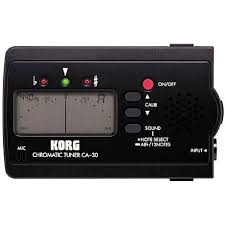

They act sort of like biofeedback: you play a note, and the needle veers left if it's flat and right if it's sharp, and there's also a light that shows red if the note is off at all and green and if it matches the frequency setting of the tuner. This particular one can also be calibrated, so you are not stuck with A 440.

It took me a fair amount of time to learn how to use this thing, but it's invaluable to me now. I keep telling people it's better than most teachers. Between this, a metronome, and my recording gadget, I have no excuses!

Until I try to get a piano in tune . . .

To be continued . . .

Wednesday, November 4, 2009

Practicing Bach

This evening was a fairly typical one for me. I stayed at work until around 7:15. I took the subway to my stop (about 15 minutes, during which I wrote in my notebook and then read a book), walked the mile to my car, and drove home, getting here around 8:00. I fed the cats, started some rice cooking, chopped vegetables for a stir-fry. My husband got home around 8:30, changed his clothes, and stir-fried dinner (I always leave the frying for him because he does it a lot better than I do). We ate, chatting about this and that. He cleaned up the kitchen while I went to the computer and tried to write something on this blog. I drank some coffee, ate a piece of cake, and read. When it was almost 11:00 I finally went to my practice room and worked on the Bach I am hoping to record this week, the C sharp major prelude and fugue from Book I of the Well-Tempered Clavier.

I've been working on this piece since March of this year. It seems to take me about 6 months to learn and memorize each of these pairs; this one took longer because the key is so puzzling -- I mean, it has B sharp in the key signature! So lots of double sharps when it modulates to other keys.
I really ought to know all the technicalities of fugue construction, but I don't. I basically can follow the theme when it comes in, but that's about it. I know that my appreciation of this music would be enhanced significantly if I would only spend a couple of hours reading about fugues and applying that knowledge to the piece. Now that I've written it down here, maybe I'll finally do it.

This evening, though, I just concentrated on playing it slowly, in short sections, from back to front. When it was feeling fairly secure, I turned on my recording gadget and made my first recording, prelude and fugue in one take. The fugue fell apart in a couple of  places, so I recorded it again. Then I put Bach aside and played some Brahms for about 15 minutes. By this time, it was after midnight. I put the piano to bed for the night, came back to the computer, copied the files over to the hard drive, and listened to them. The prelude, which I had thought went pretty well, sounds stodgy and fumbly in a few places. The second take of the fugue is actually not bad. But a lot of work yet to be done on both of them. Sigh.

As they say, tomorrow is another day.

Monday, November 2, 2009

What I'm playing this week

Bach Prelude and Fugue in C sharp major: I decided I'm going to try to record these for an online recital on the Adult Beginner's Forum at Piano World. I spent most of my practice time on them this weekend. I got the best results from slow practice (of course!) -- I set the metronome to the approximate tempo I want and then played at half of that. I'm trying to make bringing out the theme more natural instead of, "Whoops, forgot to bring out the theme again!" I am happy that I have been able to learn these at all -- this is one of the pieces that I would always skip over when sight-reading -- but I would like to be able to play them with more of a refined interpretation.

Dvorak Silent Wood: I'm learning the piano part along with the cello part. I still haven't explored the options for recording both parts, but I'm sure it can be done.

Brahms Op. 118: I decided to start learning all six of these pieces. I learned No. 1 last year, and have of course played at No. 2 for years. They are all beautiful, and they make a nice group, almost like playing a sonata.

Gershwin Prelude No. 1: Spent some time with this over the past week, and again, slow practice is the most productive.

Chopin, Prelude No. 8: I am determined to get this. It's improved from extremely halting to merely slow, but I have not been able to memorize it yet. Chopin is not hard to memorize, though. I'm not sure why.

Beethoven "Tempest" sonata: I would like to finish learning all three movements. I have the first movement from memory and dusted it off this past week but haven't gotten back to it again.

As usual, too much music, not enough time.

I was asked to play in an orchestra concert next Saturday, for pay. I considered it, but then thought about how tired and stressed out I would be from doing two evening rehearsals downtown during the week, after working all day, plus the evening concert, how I probably wouldn't have the energy to practice at all, and I turned it down. I have an almost superstitious belief that I shouldn't turn down paying gigs, but if it's something I really don't want to do and the money is not going to change my life appreciably, why can't I refuse?

Friday, October 30, 2009

Listening

I'm going to make a confession here that will sound strange: I don't like listening to music all that much. Oh, there are times when I can get into it, and I do enjoy turning on the radio and listening to the flow of programming, but in general, a lot of music just bores me. When I do listen, I prefer hearing either the best or someone who's learning -- I find both instructive. Many nicely polished performances are missing that spark of something real and warm that is so compelling in some of the old recordings, for example.

Few concerts actually appeal to me enough for me to spend the time and money attending them. The only reason I've been to as many concerts as I have has been because of my husband, who is an avid jazz listener and who also has wanted to hear classical music since he met me. But many times I have to get into a mood in which I close my eyes to the cost of the tickets and just go with the flow.

Why is this? Well, in the case of orchestras, I know most of them are just going through the motions, playing the classical top 40 over and over and over again, year after year after year. It's really a terrible shame that this is so, but there is little vitality to these types of concerts, despite the tremendous amount of talent that is often on display. They all seem to put together bland programs designed to appeal to the least ambitious, most conservative ticket buyer. I know this kind of thing has been said by many others more qualified to complain than I, but there it is.

As for soloists, recitalists, and chamber groups, it is more or less the same deal for me. Instrumentalists -- violinists, violists, cellists, wind players -- play the same handful of concertos when they solo with orchestras, and more or less the same group of sonatas and other recital pieces when they play accompanied by piano. There are some people I remember finding interesting for various reasons, or maybe it was just the circumstances under which I heard them -- perhaps if they were people that I knew, or they were playing a piece I was interested in because I was playing it, too. I always liked the Guarneri Quartet, for example, but I can't exactly tell you why.

But I must emphasize that I am embarrassed to be admitting this (on the Internet, where thousands of people can read it, yes, of course) and wish it were all different for me. I envy people who can listen attentively and then come up with incisive commentary afterward. I have never been able to offer a sincere yet thoughtful critique of other people's playing, which is especially awkward after a concert by a friend, or during a rehearsal. Every once in a while, if I'm tuned in to the piece or the performer, I can say something useful, but more often I'm standing there stammering, "Uh, that was really good!"

One exception to my listener ennui: since I have gotten back into playing the piano, I have been fascinated with seeing and hearing pianists play. However, I still don't know what to say to them after I have heard them play.

Criticism is something they ought to teach at music school. It should be a required course, along with the one in which they teach you how to earn a living.

The fact is that I'd rather play than listen.

Thursday, October 29, 2009

What's going on here?

I seem to be developing a theme here -- basically, "Man (and woman) does not live by music alone." Am I still trying to justify quitting, or my lack of success at it, by pointing out these cautionary tales of truncated, empty lives?

Or am I trying to get at why I could never throw myself into it completely? Perhaps it was a self-preservative instinct that kept me from doing so. If you don't commit, it's harder to get hurt.

Perhaps the people who crash and burn give it their all, and then they don't have anything left when things get rough.

Then there's the question of what "success" even means in this business. To me, it's always been figuring out how to set up one's life with a good balance among all of one's activities, both those necessary to survive and those that serve to feed one's interests and passions.


I know now that I've set things up so that I can work on the piano any time I want to, playing the cello doesn't make me feel sad the way it used to. All of my eggs are not in one basket.

This is something I need to think about some more.

Geoffrey Tozer

I had never heard of this pianist until a few days ago, when someone on Piano World posted a link to a story about his memorial service. He died in August of this year at the age of 54 after years of decline following early successes as a child prodigy and young man. The medical cause of his death was liver disease, developed over years of alcoholic drinking.

You can read about him here and in former Australian prime minister Paul Keating's eulogy here.

I was struck, reading about this man so soon after seeing the movie I described in my last post, by the contrast between his difficult life and those of the accomplished amateur pianists in the movie. I keep thinking about how his early concentration on music crippled his personal development.

From my admittedly quick reading of the facts, it seems that Tozer followed some very bad advice and made some very bad decisions. For example, one trusted adviser told him he should skip high school and just play concerts and meet people, which he proceeded to do. I'm sure following this course of action enabled him to develop his artistry and technical skill to a high level, but at what cost?

And then when Tozer was in his early 40s, he came to Keating's notice and ultimately was awarded grants totaling more than half a million dollars over 10 years. He certainly did many worthwhile things with the money -- such as embarking on some ambitious recording projects -- but did not establish a stable life. The grants were given by one politician and taken away by another, so they were not something anyone should have counted on for the long term.

Keating, in his eulogy, laid heavy blame for Tozer's death on the failure of the musical establishment in his own country to support and nurture this artist, and he excoriated Australia's orchestras for not supporting their home-grown genius. His comments were ill-informed. Very few classical musicians -- only those at the very top of the heap, like the Yo Yo Mas -- are supported by such hiring, which only is financially significant if the artist performs constantly at first-class venues. Most full-time musicians, even the very successful ones, put together a patchwork of jobs and count themselves lucky if they can pay the rent. Even if Tozer had performed with every orchestra in Australia several times a year, though perhaps it would have supported him emotionally, it would not have supported him materially.

I do believe that governments should support the arts because they cannot flourish under capitalism. Just because something is commercially viable does not mean that it's good. So much dreck that is passed off as music earns most of the money, and most of the real artists, whether they play classical, jazz, or other creative forms, are left to flounder and make their own way.

Thousands of very fine musicians have the same troubles as Tozer and do not self-destruct. His story is a sad one, and perhaps even a tragedy in the classical sense in which the protagonist causes his own downfall, but I sense that his problems went much deeper than lack of recognition for his art.

Monday, October 26, 2009

They Came to Play

I saw this movie this evening: They Came to Play.


It's a documentary about the 2007 Van Cliburn International Amateur Piano Competition for Outstanding Amateurs. Held in Fort Worth, Texas, every 4 years, the competition chooses 75 pianists for the preliminary round based on recorded applications, narrows them down to 25 for the semifinals, six for the finals, and then awards three prizes. Amateur is defined here someone who does not earn their living from playing or teaching piano. The requirements are much looser than for professional competitions -- there are no repertoire restrictions, and music does not need to be memorized.

The documentary was fantastic. This was the premiere showing in a commercial theater (it has been shown at several film festivals and has won prizes), and the producer of the film was there as well as a couple of the competitors, who played after the screening. If you go to the film's website at the link above, you will get a taste of the look and sound of the movie.

What was especially interesting to me was that almost all the people in the competition were middle-aged, with full-time jobs, families, and other interests. Some were older and retired from long nonmusic careers. Some had had terrible setbacks in life, such as major illness, drug problems, family problems, and dislocation from their birth countries. But they were all highly intelligent, articulate, and interesting people who had made the best of their various situations. A number of them had studied piano seriously and gone to conservatories. They were all very good players, some excellent.

I guess what I'm driving at is related to my previous post: that it's possible to have a full life, not be a starving artist, and also achieve a high level of playing an instrument. Not doing it for money (the prizes in this competition are extremely modest -- first prize is only $2,000; the real prize is getting to participate) seems to enhance the experience.

One of the competitors in the movie quoted Stravinsky: "If you can make a million dollars doing something other than music, do it."

Another, berating himself for not playing so well after he came off stage, said, "I have to turn the switch and remember that I'm an amateur!"