. . . the master class I was supposed to play in this Sunday was canceled because it's supposed to snow buckets tomorrow.
That's not the terrible part; the terrible part is that I'm immensely relieved. I was supposed to play Brahms Op. 118 No. 1, and some part of me was looking forward to it, but another part was dreading it. If it was just playing, it wouldn't be so bad, but the whole social thing always makes me nervous, too. I mentioned in an earlier post that I met the teacher many years ago, and he is a very nice person, warm and friendly, so that's not what was worrying me. (Some of the "masters" I've played for have been the nastiest-behaving people I've ever encountered. There is one very famous cellist who was so jerky to me in a master class some 20 years ago that I now refuse to even listen to him or his recordings.) I just kept thinking how weird it would be, attempting to play the piano when he knew me and accompanied me as a cellist.
One of my escapades when I was attempting to learn to play the viola was attending a "Viola Fest" weekend at a university music school. The viola teacher at the school happened to be someone I knew from college who had married one of our composition professors. He had been pretty friendly to me and even asked me to perform his cello and piano sonata with him. He was at this viola thing, too, and he said something about how it was sad seeing me struggle with the viola in comparison with my ease and naturalness on the cello. I was wondering if this pianist would think the same thing (though he probably would not say it!).
Another anxiety-producing element is the piece -- I mean, Brahms, after all. Brahms comes as a shock after learning Chopin. Many of Chopin's piano pieces are difficult, yes, but they lie naturally under the fingers, and they don't fight with the piano. Brahms's piano pieces all seem like they are trying to be something else, something orchestral, or trying to create a sound possible only in the imagination. One reason I chose to play Brahms for this master class was because I thought I could get some help with the larger issue of how to create the sound I imagine -- or at least how to try. But the fact that I'm not taking lessons makes me feel a little -- um, would the word be "cheap"? -- trying to get this kind of help in front of an audience.
I wouldn't say the main reason I'm not taking lessons is because of the expense, though that enters into it. It's more that I don't know how to find the right teacher. I'm pretty sure I will need someone different from the run-of-the-mill neighborhood piano teacher who mainly guides little kids through John Thompson, or even the more advanced level teacher who knows how to steer little geniuses through competitions. I'm not a beginner, but I'm no pro, either. It's not that easy finding someone who will teach adults at all, whatever their level. We're a tougher audience than children, and we have pesky things like full-time jobs and spouses, and we tend to get busy and cancel lessons or show up not having practiced (though the kids do that, too, as I know from teaching). For whatever reason, I have found it hard to pick up the phone and arrange to talk to some teachers, but I should do it.
Anyway, the master class will be rescheduled, probably for some more temperate time of the season, so I will get a chance to go through all of this again. And perhaps I will be better prepared than I would have been this Sunday.
Thursday, February 4, 2010

Tuesday, February 2, 2010
What nurtures creativity?
People are always moaning that they don't have enough time to engage in their chosen creative activity. It so often happens, though, that if one does have lots of time, one does not do anything particularly meaningful with it.
I often think about my mother when I think about this. She was always interested in drawing, and when she was a young married woman, she took a painting class at the Y. She spent many happy hours in the following years making oil paintings that ranged from portraits of people in the family to still lifes to quasi-abstracts, and she used them to decorate our house. I remember standing at her elbow, watching her work with delicate dabs of pigment on an artist's palette. I grew up familiar with the scent of turpentine.
When she was in her late 40s, she went back to college to get a degree in fine arts. She dutifully completed the various projects required for her classes. These included a lot of nudes, including a cast plaster sculpture and many large canvases painted with swirls of ugly colors. The instruction seemed to revolve around abstract expressionism and all its offshoots, far removed from my mother's cheerful, ladylike portraits and still lifes.
The college experience seemed to deflect her original enthusiasm. By the time she graduated, she seemed to have lost her creative spark. She had all day, every day, to paint and draw -- my younger sister and I were both in junior high school, and my older sisters were all married -- but she did very little. When finances required more income, she went out and got a job as a secretary. In subsequent years, she actually found more inspiration to paint than she had when she was not working. My sisters asked her to paint pictures for them -- of their kids, or a big canvas to decorate a wall. It was the kind of thing she enjoyed, even though her art teachers may not have approved.
After she retired and after my father died, she took up some other artistic interests, including abstract wood sculpture and Chinese calligraphy. She pursued these regularly, but it never seemed to me that she had the same absorption she did when she was younger and more in her own world. She had become too conscious of outside standards and measurements beyond her own eyes.
This has become a cautionary tale for me, though I'm not exactly sure what the moral is. Don't go to college? Well, too late for that! Maybe it's more: don't lose sight of what is original in yourself. And then the other part: don't forget what made you want to do the thing in the first place.

I often think about my mother when I think about this. She was always interested in drawing, and when she was a young married woman, she took a painting class at the Y. She spent many happy hours in the following years making oil paintings that ranged from portraits of people in the family to still lifes to quasi-abstracts, and she used them to decorate our house. I remember standing at her elbow, watching her work with delicate dabs of pigment on an artist's palette. I grew up familiar with the scent of turpentine.
When she was in her late 40s, she went back to college to get a degree in fine arts. She dutifully completed the various projects required for her classes. These included a lot of nudes, including a cast plaster sculpture and many large canvases painted with swirls of ugly colors. The instruction seemed to revolve around abstract expressionism and all its offshoots, far removed from my mother's cheerful, ladylike portraits and still lifes.
The college experience seemed to deflect her original enthusiasm. By the time she graduated, she seemed to have lost her creative spark. She had all day, every day, to paint and draw -- my younger sister and I were both in junior high school, and my older sisters were all married -- but she did very little. When finances required more income, she went out and got a job as a secretary. In subsequent years, she actually found more inspiration to paint than she had when she was not working. My sisters asked her to paint pictures for them -- of their kids, or a big canvas to decorate a wall. It was the kind of thing she enjoyed, even though her art teachers may not have approved.
After she retired and after my father died, she took up some other artistic interests, including abstract wood sculpture and Chinese calligraphy. She pursued these regularly, but it never seemed to me that she had the same absorption she did when she was younger and more in her own world. She had become too conscious of outside standards and measurements beyond her own eyes.
This has become a cautionary tale for me, though I'm not exactly sure what the moral is. Don't go to college? Well, too late for that! Maybe it's more: don't lose sight of what is original in yourself. And then the other part: don't forget what made you want to do the thing in the first place.

My mother's daylilies
Saturday, January 30, 2010
Pianos
I've written a little about my experiences with musical instruments, but I haven't described how I ended up with my current piano. It's a tale that combines money, real estate, and a bit of music.
Pianos, so familiar to most people, are complex combinations of machine and furniture, stringed instrument and percussion. I never knew much about them or thought much about them. The piano I first remember playing was a small baby grand that my parents bought at an auction house in DC when I was around 4 years old. They had seen it in the window, and asked a friend of theirs to bid on it for them; they paid around $200. It was a "Kimmel,"* one of the many off-brands that used to be produced in the United States, back when every middle-class family had, or aspired to have, a piano in the house. I always thought it was fine, though it probably was not; I rarely played any other pianos except for my teacher's studio upright (she had a grand upstairs in her house, but in the many years I took lessons from her I never went up there, so never saw it, just heard about it).
We had a lot of trouble keeping the Kimmel in tune. Our house had central forced-air heating, so it was dry in the winter and humid in the summer. The pin block was probably shot; the pins were apparently loose. I remember one tuner advising us to keep a bowl of water inside the lid, on the plate, to keep the block more humidified so the pins wouldn't slip so much. It didn't work.
I eventually inherited that piano and moved it into an apartment I had in Baltimore the year after I finished working on my doctorate and was working as a court reporter. It was in a rather luxurious older high-rise building with a doorman and garage parking, and my apartment was a spacious one-bedroom on the 11th floor. I was renting from the owner, who had bought another apartment in the building. The piano looked great in the large living room. I bought a tuning hammer so I could bring it into something approaching correct pitch, which I had to do every time I played it.
I didn't have the usual apartment problems with noisy neighbors or complaints about my practicing. The walls were thick and the place was generally quiet, except that my two windows faced on St. Paul Street, and the sound of traffic (including some very loud sirens heading to Mercy Hospital just down the street) was a constant in the apartment.
But the apartment wasn't entirely satisfactory, either. There weren't any decent grocery stores nearby, so I had to drive to the suburbs to do my shopping. Also, although the area was bustling during the day, it was almost deserted at night, and I was reluctant to go out unless I took my car, so I ended up staying home watching TV a lot. There was a real-estate lull going on at the time, and interest rates were lower. When I started thinking about maybe finding a different place to live, I got the real-estate itch after I realized that it was possible to buy something appropriate for the same cost as renting.
So that spring, I started looking at condos, and then at houses. In the midst of this, I received a flier in the mail for one of those "university piano sales": A piano store advertises a huge sale at such-and-such a location where they will be selling pianos used by a school or concert hall or theater at a deep discount and, oh yeah, some new pianos. I didn't know then that this is a come-on to getsuckers customers in the door. They usually have a few beat-up pianos available, but then the salesperson steers you to the new ones so he or she can make a bigger commission.
I ended up in the hands of a slick-talking piano salesman who sold me a new Baldwin Hamilton studio piano. Whether the price was fair or not, I have no way of knowing. Because I still hadn't bought a new place to live, although I bought the piano in April, I didn't take delivery until June (much to the salesman's dismay -- but there was nothing he could do about it).
After much searching, I decided to buy a house in the DC suburbs. It was a little Cape Cod at the end of a dead-end street. It was very quiet and peaceful, and I felt safe there. The price, in retrospect, seems ridiculously low.
Before I moved, I put a note on my apartment bulletin board, advertising the Kimmel. The only person who called was my landlord! He didn't play the piano but liked the way it looked. We worked out a deal of slightly reduced rent for a few months, and in exchange, I left the piano in the apartment.
The living room of my new house, though small, had a good spot for my new piano. I thought it sounded wonderful, and I played on it happily, though I didn't play as much as I'd imagined I would. Some pianist friends who came over were not that impressed with the piano, though they tried to be polite.
When my husband and I bought the house we have now, one of the attractions was that it has a living room large enough for a piano. But after we moved in, I found that it was difficult to practice here because the piano was right in the center of the house. Also, it sounded brash and bright, with the sound echoing around in that big space. What with one thing and another, I gave up and stopped playing the piano entirely.
Two events got me back into it. The first was that we did a remodeling project, turning the back part of our huge tandem garage into a room for me to use for practicing (at the time, I was deeply into the viola). The room turned out well. It has windows facing south and west, so it's generally sunny during the day. I painted it a soft yellow, and we had cork flooring installed and bought a deep red Persian-style rug for the floor. The second impetus for my return to the piano was when some friends offered me their old family piano. I thought it might be nice to have a piano down there just to mess around on, so I took it. It was another Baldwin, a 1920s 5-foot baby grand. Here's what it looked like in situ:

Having the piano there enabled me to play it any time I wanted to, and I found myself starting to practice again. It sounded horrible, though, and the action was rough. So I started prowling the Internet, searching for information about pianos, and as many before me have done, stumbled on Piano World.
My first thought was of having the Baldwin worked on -- new strings, hammers, and all the rest -- but the fact is that it was never a fine piano. Though my friends had always imagined it was a good instrument (it had been purchased new by their grandmother), in reality the small size is simply not compatible with a great tone, and as a practical matter, laying out the money necessary to fix up such a piano, probably around $4,000, is generally not a good investment. The thing is, you can't tell what it's going to sound like until it's done, but it's most likely going to be disappointing when you're starting with a nonprime piano like this one. Also, the poor thing had not been treated well before it came to our house. It had been kept in a room with no humidity control for many years, and there were some cracks in the soundboard that may or may not have been fatal. The more I studied the rebuilding option, the less worthwhile it seemed.
Then, also as many others do, I looked for a used piano that would satisfy me, a Yamaha or Kawai or something similar. I made the rounds of all the local stores, playing new and used, expensive and not. I visited Piano Row in New York and checked out all kinds of pianos. I kept coming back to the thought that although it was possible to buy an okay used piano for, say, $10,000, that is still a lot of money for something that wasn't really what I wanted. Just as I had done the calculations and decided it was a better investment to buy a house than a condo, I decided it was better to buy the nicest piano I could find that I could afford rather than the cheapest. (To read about how I could afford to buy a better piano, see this post.)
It was on Piano World that I read some of the buzz about Estonia pianos. Estonia, a small Baltic country, had a piano factory that was founded in 1893 and produced nice pianos. When the Soviets took over the government, they took over the piano factory as well, and quality declined. After the fall of the Berlin Wall, Estonia regained its independence, and the factory workers privatized Estonia Piano in 1993. A young Estonian pianist named Indrek Laul, a Juilliard graduate, started buying out the business in 1994 with the aim of creating a world-class piano. Within 10 years, there began to be much discussion in piano circles and even elsewhere about these surprisingly good pianos. For example, in 2003, an article was published in Forbes magazine:
A Fine Way to Treat . . . an Estonia
I was intrigued. When I finally was able to try an Estonia, I was impressed. The touch was especially good, and the quality of sound was almost as good as the best Steinway B I had played (~$70,000 -- no way!). There were other pianos that I liked, but they were much more expensive and only marginally better, or perhaps just different. I made a deal with a local dealer, and in July of 2006, my Estonia 190** was delivered.
I've been spoiled, practicing on this piano. It responds so well. I wish I had a bigger room for it, but the current setup more than meets my needs. I've had people come over, say they've never heard of Estonia, rattle off a few chords, pronounce it "bright," and leave obviously thinking I bought some odd piece of junk. But I'm the one who plays it every day, so it's my opinion that counts. My playing has improved tremendously since I acquired this piano; I'm able to produce many more nuances of tone and dynamics than on either of the Baldwins, and it's simply more pleasant to play on.
The fate of the old pianos? The Hamilton is still in the living room. I have it tuned once a year or so and play it once in a while. It's not a bad piano. It's among the last pianos that Baldwin made as a company in the United States before they were bought out; the new owners just slap the Baldwin name onto pianos made in Asia, and I don't know what they are like. It was designed to be a basic, sturdy workhorse (this is the model that used to be ubiquitous in practice rooms all over the country), and the craftsmanship with which it was made is high.
The touch and tone that I once thought were fine now feel loose and a bit clangy, but I've found that is characteristic of every Baldwin I've played. I've thought of selling it, but the few thousand dollars I'd make would not change my life, and it's kind of nice having a piano with such a different touch available -- I can try out pieces on it to see how secure they are without the support of the Estonia, and it's interesting.
As for the baby grand, I tried to give it away, but I couldn't find a suitable recipient. Our friends didn't want it back. I advertised on Freecycle and our neighborhood listserv. I was perhaps too honest about its problems, or maybe people just don't want to be bothered with such a thing these days. In any case, in the end I had it taken away by the movers who brought the Estonia, and I don't know what happened to it after that. Perhaps it was taken to a junkyard, perhaps it was dismantled for parts, perhaps it was turned into a minibar, or perhaps someone took it home and is playing on it right now.
*I wouldn't bother Googling this; there probably is nothing about it anywhere, and I've never seen another one. Maybe ours was the only one!
**190 refers to the length of the piano in centimeters, equal to 6' 3" in U.S. measurements. This is considered a "parlor grand" -- I guess referring to the days when people had parlors that were bigger than today's living rooms. Concert grands are generally either 9 or 12 feet long.
Pianos, so familiar to most people, are complex combinations of machine and furniture, stringed instrument and percussion. I never knew much about them or thought much about them. The piano I first remember playing was a small baby grand that my parents bought at an auction house in DC when I was around 4 years old. They had seen it in the window, and asked a friend of theirs to bid on it for them; they paid around $200. It was a "Kimmel,"* one of the many off-brands that used to be produced in the United States, back when every middle-class family had, or aspired to have, a piano in the house. I always thought it was fine, though it probably was not; I rarely played any other pianos except for my teacher's studio upright (she had a grand upstairs in her house, but in the many years I took lessons from her I never went up there, so never saw it, just heard about it).
We had a lot of trouble keeping the Kimmel in tune. Our house had central forced-air heating, so it was dry in the winter and humid in the summer. The pin block was probably shot; the pins were apparently loose. I remember one tuner advising us to keep a bowl of water inside the lid, on the plate, to keep the block more humidified so the pins wouldn't slip so much. It didn't work.
I eventually inherited that piano and moved it into an apartment I had in Baltimore the year after I finished working on my doctorate and was working as a court reporter. It was in a rather luxurious older high-rise building with a doorman and garage parking, and my apartment was a spacious one-bedroom on the 11th floor. I was renting from the owner, who had bought another apartment in the building. The piano looked great in the large living room. I bought a tuning hammer so I could bring it into something approaching correct pitch, which I had to do every time I played it.
I didn't have the usual apartment problems with noisy neighbors or complaints about my practicing. The walls were thick and the place was generally quiet, except that my two windows faced on St. Paul Street, and the sound of traffic (including some very loud sirens heading to Mercy Hospital just down the street) was a constant in the apartment.
But the apartment wasn't entirely satisfactory, either. There weren't any decent grocery stores nearby, so I had to drive to the suburbs to do my shopping. Also, although the area was bustling during the day, it was almost deserted at night, and I was reluctant to go out unless I took my car, so I ended up staying home watching TV a lot. There was a real-estate lull going on at the time, and interest rates were lower. When I started thinking about maybe finding a different place to live, I got the real-estate itch after I realized that it was possible to buy something appropriate for the same cost as renting.
So that spring, I started looking at condos, and then at houses. In the midst of this, I received a flier in the mail for one of those "university piano sales": A piano store advertises a huge sale at such-and-such a location where they will be selling pianos used by a school or concert hall or theater at a deep discount and, oh yeah, some new pianos. I didn't know then that this is a come-on to get
I ended up in the hands of a slick-talking piano salesman who sold me a new Baldwin Hamilton studio piano. Whether the price was fair or not, I have no way of knowing. Because I still hadn't bought a new place to live, although I bought the piano in April, I didn't take delivery until June (much to the salesman's dismay -- but there was nothing he could do about it).
After much searching, I decided to buy a house in the DC suburbs. It was a little Cape Cod at the end of a dead-end street. It was very quiet and peaceful, and I felt safe there. The price, in retrospect, seems ridiculously low.
Before I moved, I put a note on my apartment bulletin board, advertising the Kimmel. The only person who called was my landlord! He didn't play the piano but liked the way it looked. We worked out a deal of slightly reduced rent for a few months, and in exchange, I left the piano in the apartment.
The living room of my new house, though small, had a good spot for my new piano. I thought it sounded wonderful, and I played on it happily, though I didn't play as much as I'd imagined I would. Some pianist friends who came over were not that impressed with the piano, though they tried to be polite.
When my husband and I bought the house we have now, one of the attractions was that it has a living room large enough for a piano. But after we moved in, I found that it was difficult to practice here because the piano was right in the center of the house. Also, it sounded brash and bright, with the sound echoing around in that big space. What with one thing and another, I gave up and stopped playing the piano entirely.
Two events got me back into it. The first was that we did a remodeling project, turning the back part of our huge tandem garage into a room for me to use for practicing (at the time, I was deeply into the viola). The room turned out well. It has windows facing south and west, so it's generally sunny during the day. I painted it a soft yellow, and we had cork flooring installed and bought a deep red Persian-style rug for the floor. The second impetus for my return to the piano was when some friends offered me their old family piano. I thought it might be nice to have a piano down there just to mess around on, so I took it. It was another Baldwin, a 1920s 5-foot baby grand. Here's what it looked like in situ:
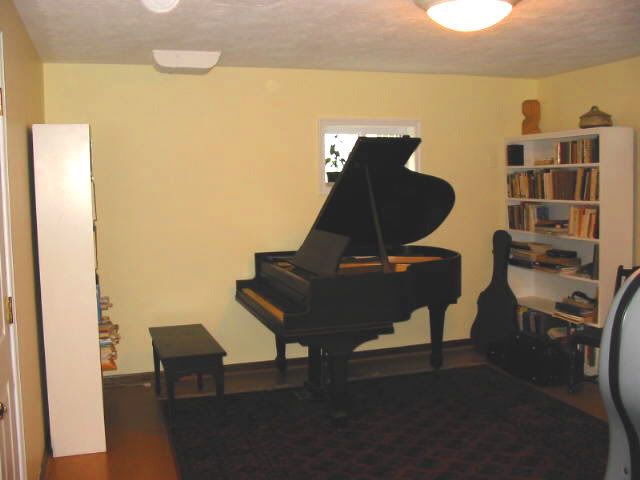
Having the piano there enabled me to play it any time I wanted to, and I found myself starting to practice again. It sounded horrible, though, and the action was rough. So I started prowling the Internet, searching for information about pianos, and as many before me have done, stumbled on Piano World.
My first thought was of having the Baldwin worked on -- new strings, hammers, and all the rest -- but the fact is that it was never a fine piano. Though my friends had always imagined it was a good instrument (it had been purchased new by their grandmother), in reality the small size is simply not compatible with a great tone, and as a practical matter, laying out the money necessary to fix up such a piano, probably around $4,000, is generally not a good investment. The thing is, you can't tell what it's going to sound like until it's done, but it's most likely going to be disappointing when you're starting with a nonprime piano like this one. Also, the poor thing had not been treated well before it came to our house. It had been kept in a room with no humidity control for many years, and there were some cracks in the soundboard that may or may not have been fatal. The more I studied the rebuilding option, the less worthwhile it seemed.
Then, also as many others do, I looked for a used piano that would satisfy me, a Yamaha or Kawai or something similar. I made the rounds of all the local stores, playing new and used, expensive and not. I visited Piano Row in New York and checked out all kinds of pianos. I kept coming back to the thought that although it was possible to buy an okay used piano for, say, $10,000, that is still a lot of money for something that wasn't really what I wanted. Just as I had done the calculations and decided it was a better investment to buy a house than a condo, I decided it was better to buy the nicest piano I could find that I could afford rather than the cheapest. (To read about how I could afford to buy a better piano, see this post.)
It was on Piano World that I read some of the buzz about Estonia pianos. Estonia, a small Baltic country, had a piano factory that was founded in 1893 and produced nice pianos. When the Soviets took over the government, they took over the piano factory as well, and quality declined. After the fall of the Berlin Wall, Estonia regained its independence, and the factory workers privatized Estonia Piano in 1993. A young Estonian pianist named Indrek Laul, a Juilliard graduate, started buying out the business in 1994 with the aim of creating a world-class piano. Within 10 years, there began to be much discussion in piano circles and even elsewhere about these surprisingly good pianos. For example, in 2003, an article was published in Forbes magazine:
A Fine Way to Treat . . . an Estonia
I was intrigued. When I finally was able to try an Estonia, I was impressed. The touch was especially good, and the quality of sound was almost as good as the best Steinway B I had played (~$70,000 -- no way!). There were other pianos that I liked, but they were much more expensive and only marginally better, or perhaps just different. I made a deal with a local dealer, and in July of 2006, my Estonia 190** was delivered.
I've been spoiled, practicing on this piano. It responds so well. I wish I had a bigger room for it, but the current setup more than meets my needs. I've had people come over, say they've never heard of Estonia, rattle off a few chords, pronounce it "bright," and leave obviously thinking I bought some odd piece of junk. But I'm the one who plays it every day, so it's my opinion that counts. My playing has improved tremendously since I acquired this piano; I'm able to produce many more nuances of tone and dynamics than on either of the Baldwins, and it's simply more pleasant to play on.
The fate of the old pianos? The Hamilton is still in the living room. I have it tuned once a year or so and play it once in a while. It's not a bad piano. It's among the last pianos that Baldwin made as a company in the United States before they were bought out; the new owners just slap the Baldwin name onto pianos made in Asia, and I don't know what they are like. It was designed to be a basic, sturdy workhorse (this is the model that used to be ubiquitous in practice rooms all over the country), and the craftsmanship with which it was made is high.
The touch and tone that I once thought were fine now feel loose and a bit clangy, but I've found that is characteristic of every Baldwin I've played. I've thought of selling it, but the few thousand dollars I'd make would not change my life, and it's kind of nice having a piano with such a different touch available -- I can try out pieces on it to see how secure they are without the support of the Estonia, and it's interesting.
As for the baby grand, I tried to give it away, but I couldn't find a suitable recipient. Our friends didn't want it back. I advertised on Freecycle and our neighborhood listserv. I was perhaps too honest about its problems, or maybe people just don't want to be bothered with such a thing these days. In any case, in the end I had it taken away by the movers who brought the Estonia, and I don't know what happened to it after that. Perhaps it was taken to a junkyard, perhaps it was dismantled for parts, perhaps it was turned into a minibar, or perhaps someone took it home and is playing on it right now.
*I wouldn't bother Googling this; there probably is nothing about it anywhere, and I've never seen another one. Maybe ours was the only one!
**190 refers to the length of the piano in centimeters, equal to 6' 3" in U.S. measurements. This is considered a "parlor grand" -- I guess referring to the days when people had parlors that were bigger than today's living rooms. Concert grands are generally either 9 or 12 feet long.
Tuesday, January 26, 2010
Yer Blues, or a little navel gazing
I don't know if other people experience this -- though I'd guess they do -- but the slump I feel after a performance is in direct inverse proportion to the importance of the performance. For me, this last concert was high profile. It was in front of a fairly large (at least 100 people), at least partly paying (either subscribers or individual ticket buyers at $15 to $20 each), audience with some expectations of me (e.g., one person called out to me afterward something like, "Up to your usual high standards!"). Some were friends and acquaintances who had never heard me before, including one of the managers from work. I also put really a lot of work into preparing, as you may have noticed if you've been reading my posts here.
That it went well has left me with a peculiarly deflated feeling that I've been trying to pin down. It is perhaps composed somewhat of the awareness that this was a little taste of what I spent so many years preparing for and the realization that yes, if I work hard enough I can still play pretty well under pressure. Playing well in front of an audience provides a bit of a high, from the adrenaline and the creative energy. There's perhaps a little niggling feeling that maybe that is what I should be doing rather than sitting in an office all day peering at manuscripts and page proofs.
If I were to play the piece again, particularly in the near future, it would perhaps go even better. But I will probably never play it again -- or at least not with an orchestra. There's some sadness in this.
And then, I have now turned to the problem of preparing a short Brahms piano piece for a master class in about a week and a half, and this is showing me how my piano playing has such a very long way to go. My struggles make me wonder what on earth I was thinking even signing up for this. And the fact that I know the teacher from way back when we were both much younger (and when I was rather supremely dorky) introduces a certain social anxiety to the situation.
Adding an extra little something to all this was a comment made about me during what I thought was an innocent discussion on Piano World the other day. I posted a question, asking about editions of the Beethoven piano sonatas, and people offered lots of interesting comments and recommendations. I thought it was a nice thread with useful information. But then one person decided to get snotty about it. He (or she, but I think it's a he) seemed to have gotten his/her panties in a twist about the cost of some of the better editions -- who knows why? Money troubles? Reverse snobbery?
I need to explain that I currently have a silly signature line that looks like this:
Recovering cellist, amateur pianist.

So someone with the screen name "Entheo" said:
That's my ramble on my state of mind this week, for what it's worth.
That it went well has left me with a peculiarly deflated feeling that I've been trying to pin down. It is perhaps composed somewhat of the awareness that this was a little taste of what I spent so many years preparing for and the realization that yes, if I work hard enough I can still play pretty well under pressure. Playing well in front of an audience provides a bit of a high, from the adrenaline and the creative energy. There's perhaps a little niggling feeling that maybe that is what I should be doing rather than sitting in an office all day peering at manuscripts and page proofs.
If I were to play the piece again, particularly in the near future, it would perhaps go even better. But I will probably never play it again -- or at least not with an orchestra. There's some sadness in this.
And then, I have now turned to the problem of preparing a short Brahms piano piece for a master class in about a week and a half, and this is showing me how my piano playing has such a very long way to go. My struggles make me wonder what on earth I was thinking even signing up for this. And the fact that I know the teacher from way back when we were both much younger (and when I was rather supremely dorky) introduces a certain social anxiety to the situation.
Adding an extra little something to all this was a comment made about me during what I thought was an innocent discussion on Piano World the other day. I posted a question, asking about editions of the Beethoven piano sonatas, and people offered lots of interesting comments and recommendations. I thought it was a nice thread with useful information. But then one person decided to get snotty about it. He (or she, but I think it's a he) seemed to have gotten his/her panties in a twist about the cost of some of the better editions -- who knows why? Money troubles? Reverse snobbery?
I need to explain that I currently have a silly signature line that looks like this:
Recovering cellist, amateur pianist.
So someone with the screen name "Entheo" said:
ah, if only spending the extra money would allow us 'recovering cellists' and 'amateur pianists' to perform beethoven in the brendelian manner, then my credit card would be at the ready.Well, gosh. And no one really came to my defense, either. Well, what can you expect from a bunch of pixels? I'll just tootle off in my overpriced edition of the Beethoven sonatas (which should arrive in the mail next week) and leave them to insult each other if that's what turns them on.
. . . i must say i think this thread became a bit of a runaway train wrt setting expectations of what editions are appropriate and which ones are not for those of us who are simply trying to scale these mountains, not necessarily with the panache befitting these monuments. but if owning a lamborghini that you are only capable of driving 50 mph is your thing, more power to you.
That's my ramble on my state of mind this week, for what it's worth.
Wednesday, January 20, 2010
What I'm playing this week
On the piano:
Bach Prelude and Fugue, WTCII/2: I'm still working on memorizing the fugue. I know I keep practicing it too fast; I think going through it slowly a number of times will settle it down a lot. But it's close to being learned, after two months. This is the shortest one I've tried, though -- each piece is only a page long, so there's a lot less to learn than the C sharp major from WTCI, for example.
Brahms Op. 118: I've been concentrating on Nos. 1 and 2 this week. No. 1 is still eluding me, and I don't know why. I think it's because I don't understand it.
No. 2, though it's played by kids the world over, is also eluding me. Brahms is just so thick, and when I really try to play every note cleanly, I have trouble with voicing. Memorizing is tricky because there are changes in each repetition of a theme. In this particular piece, the structure is ABA; within the first A, there are two sections. In the second A, the first section of the first A is a variation rather than a repeat, but then the second section is an exact repeat of the parallel section in the first A. The B section also comprises an ABA structure, with the second A a variation on the first.
Gershwin Preludes: I've been feeling very crabby about these pieces. I cannot seem to make them clean. Perhaps I am coming up to the limits of my knowledge of piano technique, and this is the time I should start looking for a teacher.
Chopin Op. 55 No. 1 Nocturne: This is coming back fairly quickly. It feels much less difficult than it did the first time around.
Cello:
Vacation time! I haven't touched it since Sunday.
Bach Prelude and Fugue, WTCII/2: I'm still working on memorizing the fugue. I know I keep practicing it too fast; I think going through it slowly a number of times will settle it down a lot. But it's close to being learned, after two months. This is the shortest one I've tried, though -- each piece is only a page long, so there's a lot less to learn than the C sharp major from WTCI, for example.
Brahms Op. 118: I've been concentrating on Nos. 1 and 2 this week. No. 1 is still eluding me, and I don't know why. I think it's because I don't understand it.
No. 2, though it's played by kids the world over, is also eluding me. Brahms is just so thick, and when I really try to play every note cleanly, I have trouble with voicing. Memorizing is tricky because there are changes in each repetition of a theme. In this particular piece, the structure is ABA; within the first A, there are two sections. In the second A, the first section of the first A is a variation rather than a repeat, but then the second section is an exact repeat of the parallel section in the first A. The B section also comprises an ABA structure, with the second A a variation on the first.
Gershwin Preludes: I've been feeling very crabby about these pieces. I cannot seem to make them clean. Perhaps I am coming up to the limits of my knowledge of piano technique, and this is the time I should start looking for a teacher.
Chopin Op. 55 No. 1 Nocturne: This is coming back fairly quickly. It feels much less difficult than it did the first time around.
Cello:
Vacation time! I haven't touched it since Sunday.
Sunday, January 17, 2010
Done!
The concert is over!
I'm overall satisfied with how I did. My criticisms:
The good things:
Silent Woods, live in DC
I'd be happy to read any comments. I'd probably be happier to read good ones than bad ones, but constructive criticism is welcome.
I'm overall satisfied with how I did. My criticisms:
- I didn't quite make a couple of the shifts (i.e., the shifted-to note wasn't in tune).
- There is an obvious struggle between the tempo I wanted and the tempo the conductor wanted (mine was faster). This was something I had no control over. I decided I was just going to keep going and let the chips fall where they would. Some of the chips were probably related to my first criticism.
- My interpretation was pretty basic. There is much more one could evoke from this music.
The good things:
- My tone was good.
- Bowing was clean and not wobbly.
- I felt a connection with the music.
- The audience seemed to respond well.
- I was not paralyzingly nervous! It actually was almost fun once I got out there in front of the audience.
Silent Woods, live in DC
I'd be happy to read any comments. I'd probably be happier to read good ones than bad ones, but constructive criticism is welcome.
The hazards of practicing
Yesterday, the skin on the tip of my left-hand middle finger and right-hand thumb cracked at the nail. It's been cold and dry here, and I've been putting lotion on my hands, but it wasn't enough to prevent this. This has happened to me before, but never right before a concert when I was playing a solo like this.
When the skin cracks at crucial points of contact like that, the pain is bad. When you press down on a string with a cracked fingertip, it feels like someone is sticking a needle into your finger.
I put some New-Skin® on both places (basically similar to clear nail polish with a few purifying ingredients in it), which helped, but it still hurt. I woke up this morning feeling like pressing my finger down on a metal wire was the last thing in the world I wanted to do.
So I just spent a half hour working on my hands. I cleaned all the New Skin off with nail polish remover, soaked my hands in hot water (really helped remove the soreness), and reapplied some fresh New-Skin -- one coat, let that dry, then another coat. Then lotion.
The concert will take place in about four hours. I'm hoping it won't be too much like getting a tooth drilled without anesthesia.
When the skin cracks at crucial points of contact like that, the pain is bad. When you press down on a string with a cracked fingertip, it feels like someone is sticking a needle into your finger.
I put some New-Skin® on both places (basically similar to clear nail polish with a few purifying ingredients in it), which helped, but it still hurt. I woke up this morning feeling like pressing my finger down on a metal wire was the last thing in the world I wanted to do.
So I just spent a half hour working on my hands. I cleaned all the New Skin off with nail polish remover, soaked my hands in hot water (really helped remove the soreness), and reapplied some fresh New-Skin -- one coat, let that dry, then another coat. Then lotion.
The concert will take place in about four hours. I'm hoping it won't be too much like getting a tooth drilled without anesthesia.
Subscribe to:
Posts (Atom)


