I've been working on the Bach prelude and fugue in A major from Well-Tempered Clavier, Book I, for six months now. For some reason this piece has been especially difficult for me. Sometimes I have thought that it doesn't engage me much emotionally, so my mind wanders while I'm playing it. (I find myself thinking all kinds of things -- some very far afield!) I have a vague mental picture of the prelude being something pastoral and the fugue being something along the lines of a hunting song, or a jig (or should I say "gigue"?), but I couldn't seem to get deeply into it.
Anyway, I told myself I'd work on it until I could produce a reasonably okay recording and then move on. About a month ago, I made a recording that sort of met that criterion. In fact, the fugue came out especially well. I wasn't satisfied with the prelude, though, so I figured I'd work on it a little more and maybe rerecord the prelude.
Time went by without my getting around to it, and in the interim, I had the piano tuned, so the possibility of joining the older recording of the fugue with a new recording of the prelude was less likely to be convincing (i.e., the latter was going to be significantly sharper than the former). I spent some frustrating hours trying to get a decent recording of both prelude and fugue, but nothing came up to the level of the version I recorded a month ago, so I decided in the interest of my sanity (or facsimile thereof) to throw this up here and call it a half year and move on:
Bach WTC I/19 in A major
I apologize in advance for a couple of oopsies in the prelude. This does have the virtue of having been recorded in one take, though!
Sunday, October 17, 2010

Thursday, October 7, 2010
Music in Maine
This past weekend we finally made it to Maine. The original plan, two years ago, was for three of us (the three women who are in our neighborhood folk-ish band) to travel there to play with an accordion player the recorder player has known for 30+ years. He used to live in this area and retired about five years ago to Maine. But then the violinist had a family emergency and couldn't go, and we canceled it.
In the middle of last week, the violinist came down with something, and she still didn't feel good by Friday, so she again ended up not going. But because our spouses were coming along and we were all looking at it as more of a general vacation than an all-music kind of thing, we forged ahead this time.
Part of the deal was that I had to pick up a rental cello on the way from the airport, so each couple rented a car and drove separately. One of my imaginary friends from the Internet lives sort of on the way, so we decided to stop in and see her and her husband. I was totally zonked from getting up at 5:00 that morning, but we had a nice visit, and I played a little on her Seiler grand.

(That's my husband sitting on the couch in the background.)
She also has a fractional-sized cello (maybe a three-quarter-sized one?) that she wanted me to check out -- her husband picked it up for her on a whim from a pawn shop years ago. It is not bad sounding but needs new strings and some tweaking. (It was tuned a half step flat, and I was afraid to tune it up because the strings looked like they were about to pop.)
Back on the road, we headed for Glen Cove and Woodsound Studio, a nice little shop that services and sells mostly stringed instruments, with a few folk-oriented ones as well. They gave me a very good-sounding Romanian-made student cello, and judging from the way the cello was set up, they know what they're doing.
We then continued on to Southwest Harbor. Our B&B faced a picturesque tree-lined street, and from the back of the house, you can see the water. After a quick dinner at one of the restaurants up the street, we went down to the basement of the B&B for the first of what turned out to be only two sessions with the accordion player. He was really busy and couldn't give us much time. We played through some of our repertoire for about an hour, and then he had to leave. So that was Saturday.
We met again on Sunday morning for about two hours. We decided to liberate ourselves from the dark basement room and started out playing outside on one of the porches:
 However, it was really too cold to play outside, so we moved indoors and played while the cleaning person and other guests picked their way around us.
It was bothering me that I'd rented this cello to play it for only three hours, so on Monday evening, I suggested to the recorder player that we play as a duo. She asked our hosts at the B&B if it would be okay, and they got excited and asked if we'd like to entertain the other guests at an impromptu cocktail party. So while they shook up some Cosmopolitans and set out dishes of tapenade, we set up in the dining room and played for a while -- quite a bit different without a rhythm instrument, but it wasn't too bad. We wound up our session and then drove down the road to visit the accordionist's wife (he had had to go out of town that morning, but she invited us over for a short visit). It turns out that she was a music major at Wellesley back in the day, though she doesn't play much now. She has a baby grand piano -- a Hardman -- and she asked me to play a bit. So I played my Bach prelude and Brahms Op. 118 No. 2 (the latter with a big brainfart hole at the end, unfortunately; I wonder why that happens?).
The rest of the time, we did vacationer-type things like going on hikes and eating seafood. The weather was beautiful, aside from a little rain on Monday morning.
It was a pleasant trip, and I liked getting in some playing (I always feel better when I can play music), though renting the cello was a bit of a pain. I suppose I could have bought a seat for my own cello on the plane, but that is always an iffy proposition (sometimes the airport people won't let you bring it on board if the flight is crowded), and then I'd have had to worry about it the entire time. I've done my share of traveling with a cello, and it's a hassle however you arrange it.
If money were no object, I'd get one of these: That Carbon Fiber Cello
But with my traveling-with-cello career as limited as it is at the moment, I can't justify it.
In the middle of last week, the violinist came down with something, and she still didn't feel good by Friday, so she again ended up not going. But because our spouses were coming along and we were all looking at it as more of a general vacation than an all-music kind of thing, we forged ahead this time.
Part of the deal was that I had to pick up a rental cello on the way from the airport, so each couple rented a car and drove separately. One of my imaginary friends from the Internet lives sort of on the way, so we decided to stop in and see her and her husband. I was totally zonked from getting up at 5:00 that morning, but we had a nice visit, and I played a little on her Seiler grand.
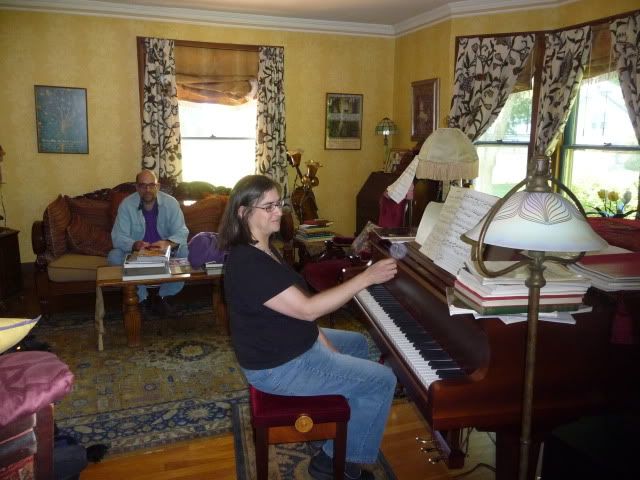
(That's my husband sitting on the couch in the background.)
She also has a fractional-sized cello (maybe a three-quarter-sized one?) that she wanted me to check out -- her husband picked it up for her on a whim from a pawn shop years ago. It is not bad sounding but needs new strings and some tweaking. (It was tuned a half step flat, and I was afraid to tune it up because the strings looked like they were about to pop.)
Back on the road, we headed for Glen Cove and Woodsound Studio, a nice little shop that services and sells mostly stringed instruments, with a few folk-oriented ones as well. They gave me a very good-sounding Romanian-made student cello, and judging from the way the cello was set up, they know what they're doing.
We then continued on to Southwest Harbor. Our B&B faced a picturesque tree-lined street, and from the back of the house, you can see the water. After a quick dinner at one of the restaurants up the street, we went down to the basement of the B&B for the first of what turned out to be only two sessions with the accordion player. He was really busy and couldn't give us much time. We played through some of our repertoire for about an hour, and then he had to leave. So that was Saturday.
We met again on Sunday morning for about two hours. We decided to liberate ourselves from the dark basement room and started out playing outside on one of the porches:
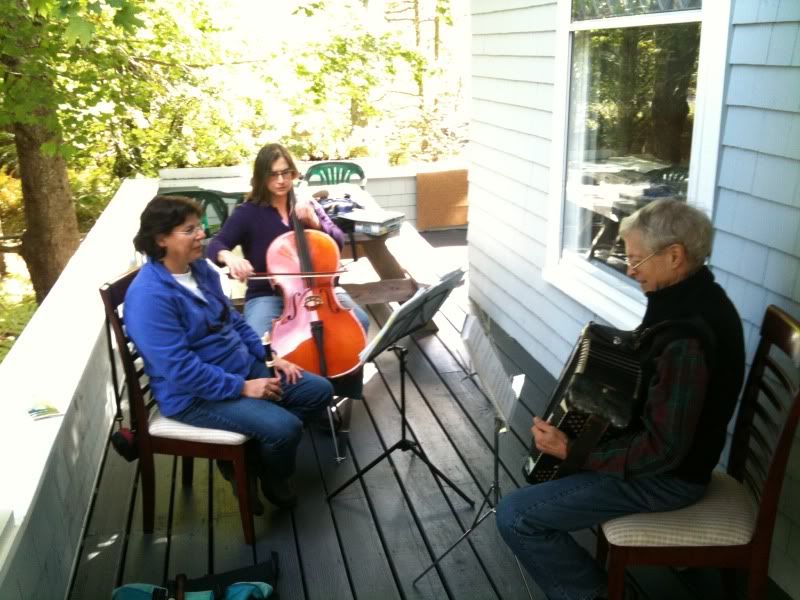
It was bothering me that I'd rented this cello to play it for only three hours, so on Monday evening, I suggested to the recorder player that we play as a duo. She asked our hosts at the B&B if it would be okay, and they got excited and asked if we'd like to entertain the other guests at an impromptu cocktail party. So while they shook up some Cosmopolitans and set out dishes of tapenade, we set up in the dining room and played for a while -- quite a bit different without a rhythm instrument, but it wasn't too bad. We wound up our session and then drove down the road to visit the accordionist's wife (he had had to go out of town that morning, but she invited us over for a short visit). It turns out that she was a music major at Wellesley back in the day, though she doesn't play much now. She has a baby grand piano -- a Hardman -- and she asked me to play a bit. So I played my Bach prelude and Brahms Op. 118 No. 2 (the latter with a big brainfart hole at the end, unfortunately; I wonder why that happens?).
The rest of the time, we did vacationer-type things like going on hikes and eating seafood. The weather was beautiful, aside from a little rain on Monday morning.
It was a pleasant trip, and I liked getting in some playing (I always feel better when I can play music), though renting the cello was a bit of a pain. I suppose I could have bought a seat for my own cello on the plane, but that is always an iffy proposition (sometimes the airport people won't let you bring it on board if the flight is crowded), and then I'd have had to worry about it the entire time. I've done my share of traveling with a cello, and it's a hassle however you arrange it.
If money were no object, I'd get one of these: That Carbon Fiber Cello
But with my traveling-with-cello career as limited as it is at the moment, I can't justify it.
Tuesday, September 28, 2010
Slow progress, or the magical powers of lack of speed
Over the summer, I spent several months flailing at Beethoven Op. 2 No. 3, his grand C major sonata, learning the notes but not playing them very well. When I finally buckled down and started practicing the Beethoven at a relaxed slow tempo (not painfully slow, but slow enough to attend to every note), it got better miraculously, in just a session or two. This sonata, for those not familiar with it, is written in a virtuosic style, almost like a concerto. It's Beethoven at his most cheerful, as well as Beethoven showing off his chops. There are both pianistic and compositional flourishes throughout. The main theme is particularly devilish because it features four 16th notes played in thirds in the right hand on the third beat of the first and third measures. It doesn't look like anything much, but it's quite difficult because it forces you to play these rapid notes in thirds with emphasis on the fourth and fifth fingers -- the weakest ones -- right at the beginning of the piece. Also, the Allegro con brio temp compounds the difficulty.
 I may have mentioned that I worked on this piece a little when I was 17 with a teacher I had for only a short time. He assigned it because I had worked on Op. 2 No. 2 for years on end with my previous teacher, so with his logical Germanic mind, of course I needed to continue with No. 3. I struggled with those first measures. When I asked him how one could possibly play them, he said, basically, "Practice." I finally gave up on the piece because I could not play those measures. Well, I didn't know how to practice then -- but I do now.
My fancy-pants ABRSM edition by Barry Cooper helps. Back when I didn't know any better, I was using Schirmer, which is chock full of horrible overedited anachronistic markings. I'm pretty sure they had those first measures slurred. Cooper points out that the 16th notes are actually NOT slurred into the two eighths at the end of the first measure, nor are the eighth notes slurred into the second measure. So if you play this figure fairly crisply and separated, it not only sounds better but is easier.
My slow practicing is also soothing all the muscles and tendons in my overstrained right wrist. Shortly after I began working on this sonata, I started feeling a lot of pain there -- not carpal tunnel type pain, but a definite and severe pain on the outside of that wrist. In the week or so that I stopped trying to force it in a fast tempo I can't play yet, the pain has eased.
So -- here's to slow progress, though I continue to wonder why it's so hard to make myself do it.
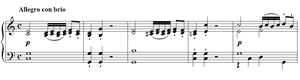
My fancy-pants ABRSM edition by Barry Cooper helps. Back when I didn't know any better, I was using Schirmer, which is chock full of horrible overedited anachronistic markings. I'm pretty sure they had those first measures slurred. Cooper points out that the 16th notes are actually NOT slurred into the two eighths at the end of the first measure, nor are the eighth notes slurred into the second measure. So if you play this figure fairly crisply and separated, it not only sounds better but is easier.
My slow practicing is also soothing all the muscles and tendons in my overstrained right wrist. Shortly after I began working on this sonata, I started feeling a lot of pain there -- not carpal tunnel type pain, but a definite and severe pain on the outside of that wrist. In the week or so that I stopped trying to force it in a fast tempo I can't play yet, the pain has eased.
So -- here's to slow progress, though I continue to wonder why it's so hard to make myself do it.
Monday, September 20, 2010
Blogaversary and goals

I tend to take stock and compare with the year gone by more at this time of year than when the calendar turns in January; maybe it's my Jewish heritage coming out, or maybe it's just that I spent so many years in school. In any case, I've been thinking about what I've learned this past year and my musical goals for the near future.
Aside from a lot of pondering on philosophical questions, what I've actually done amounts to this:
September 2009: I played the cello at one of the English country dances at Glen Echo. I like doing these because the other musicians are usually very good, and it's a chance to practice improvising skills.
October 2009: I recorded Chopin Op. 27 No. 1, playing from memory. I felt that this was a good start on this piece. I think if I ever relearn it, it will be much better. I also played a concert with my chamber orchestra.
November 2009: I recorded the Bach Prelude and Fugue in C sharp major, Well-Tempered Clavier Book I, No. 3. I felt pretty good about this one. This is one of those pieces that I couldn't even imagine being able to play, let alone memorize, back in the day.
December 2009: I played the cello at two holiday folk events: an English country dance and a Scandinavian dance. These were with the large and loosely (very loosely) organized group that's been around for about 30 years, and they were what they were.
January 2010: I performed Dvorak's "Silent Woods" with an orchestra, playing from memory. This was one of the more satisfying cello performances I've done. The sound was close to what I imagined it should be, I felt comfortable in front of the audience, and I felt well prepared. This is also the first solo piece that I prepared for an important concert completely on my own from the beginning. It made me feel like a pro. On this same concert, we also played Brahms's Symphony No. 2, for which I coached the cello section, and I think we acquitted ourselves very respectably.
February 2010: I relearned and rerecorded Chopin Op. 55 No. 1. I felt good about how quickly I was able to redo this piece; however, I was not very happy with my performance. Though clean, it was just too, too fast. I should have recorded it a few more times, at least, to try to create a better interpretation. I think I was just feeling burned out about it and like no one really cared.
March 2010: I played the cello at an English country dance ball with two excellent folk musicians. I did a decent job, but nothing amazing. Not a high point of the year, though I'm glad I had the chance to do it.
April 2010: I recorded both the Bach Prelude and Fugue from WTC Book II, No. 2, in C minor, and Brahms Op. 118 No. 2. The Bach left a lot to be desired -- I think I just did not work on it correctly. I did too much fast playing and not enough slow playing. The Brahms, on the other hand, was gratifying because I finally memorized it and played it as well as your average anyone else. I continue to have the sneaking suspicion that I'm getting away with something by not having a teacher and not doing things the "traditional" way -- though of course, there are as many traditions as there are people, which is to say, a lot. I also played the third concert of the year with my chamber orchestra.
May 2010: I performed the Brahms on a recital. I didn't post the recording here at the time, but actually, I like it better than the one I did post here in April. It was more musical, even with the oopsies. I also played a long gig on the cello with our neighborhood group, where I felt I honed my improvisation skills a bit.
June, July, and August: In June, I played the final concert of the year with my chamber orchestra. In July, I played the Brahms in a master class for my old friend Brian Ganz, which was an interesting experience, and in August, I played the cello in a very large DC Youth Orchestra reunion concert at the Kennedy Center.
September 2010: Our neighborhood group played a gig that was relatively polished (if one can describe folk music as being "polished").
What I am happy about, looking at the list above, is that I continued to apply myself, both to continuing activities and to learning new things, throughout the year. Every month I did at least one musically engaging activity.
So what do I hope to accomplish in the coming year?
1. I'll continue to practice the piano every day. This seems to be a good thing to do. Though I heard this for years (i.e., "practice every day!"), what got me to actually do it was the MOYD challenge started by a Piano World member a few years back.
Click here for the link to the PW thread.
So there is some worthwhile stuff on the Internet.
2. I would really, really like to get better at performing on the piano. To that end, I will schedule at least a few performances on AMSF recitals. I can never decide whether it's better to do as many as possible, even if I don't feel prepared, or to play only when I feel as ready as possible. There are pros and cons to both approaches. One pro to doing lots of these is that you get a lot of experience at dealing with nerves and learning what to do to combat them. OTOH, bad performing experiences can have a detrimental effect on one's psyche; if you continue to have them, that's what you're practicing rather than playing music for people. So it's tricky.
3. I'm still going back and forth about taking lessons. What I'm contemplating now is going to someone to get help with specific pieces -- for example, the first movement of the Beethoven sonata I'm working on, which I would like to play on a recital in about two months, has multiple technical issues that I could use help with. And I'd like to see if there's a better way to learn Bach than what I've been doing. My experience with lessons throughout my life has not been so great overall; for one useful comment, I've had to put up with months, or even years, of not-so-helpfulness (or worse).
4. Other than that, I plan to just carry on carrying on.
If anyone is still out there reading (I know a few of you do check in from time to time), I hope you find at least some of my musings interesting, entertaining, or useful. Let me know! Comments are always fun to read.
So here's to another year.
Saturday, September 11, 2010
Musical Saturday - update (recording added)
This morning was the first rehearsal of the season for the chamber orchestra I'm in. I have to admit that I'm disappointed with the choice of rep for this concert. The "big" piece is an arrangement of Debussy's "Children's Corner," which though charming for solo piano is more than a bit weird for orchestra. Then there is Beethoven's overture for "The Ruins of Athens," a double flute concerto by Cimarosa, and Haydn's symphony that is nicknamed "The Bear." Oh, well; at least I don't need to practice much for this concert.
Then this evening, our little neighborhood band had a gig. Our recorder player is friends with someone who works for Hostelling International, and we've played a couple of times at the hostel in Baltimore that he's involved with, which is a 19-century mansion downtown. We've enjoyed playing there because the main room has really great acoustics. Here's a picture of us playing there last year (love those big windows!):

The event tonight was a social part of a meeting of the organization, and they hired us to provide background music during a (nonalcoholic) cocktail hour, with a break in the middle while they made a presentation.
It was generally a good gig, but the room got so noisy we could hardly hear ourselves. However, several people told us afterward that they enjoyed hearing us. One guy staked out a spot next to us and asked us if we had a CD. Well, I did say it was noisy in there. I think it was good for us as a group because it prodded us to put together a nice playlist that seemed to work well -- a combination of slow and fast, folk and jazz-lite -- and we managed to hang together pretty well.
But I am so tired now . . .
Here's a recording (first number, before the noise level went up); there's some room noise at the end that I didn't have a chance to edit out. Also, you may notice that the guitar is loud and the cello is soft (for a change); that's because we put the recording thingy next to the guitarist so it would be out of the way. I was on the other side of the group.
Then this evening, our little neighborhood band had a gig. Our recorder player is friends with someone who works for Hostelling International, and we've played a couple of times at the hostel in Baltimore that he's involved with, which is a 19-century mansion downtown. We've enjoyed playing there because the main room has really great acoustics. Here's a picture of us playing there last year (love those big windows!):

The event tonight was a social part of a meeting of the organization, and they hired us to provide background music during a (nonalcoholic) cocktail hour, with a break in the middle while they made a presentation.
It was generally a good gig, but the room got so noisy we could hardly hear ourselves. However, several people told us afterward that they enjoyed hearing us. One guy staked out a spot next to us and asked us if we had a CD. Well, I did say it was noisy in there. I think it was good for us as a group because it prodded us to put together a nice playlist that seemed to work well -- a combination of slow and fast, folk and jazz-lite -- and we managed to hang together pretty well.
But I am so tired now . . .
Here's a recording (first number, before the noise level went up); there's some room noise at the end that I didn't have a chance to edit out. Also, you may notice that the guitar is loud and the cello is soft (for a change); that's because we put the recording thingy next to the guitarist so it would be out of the way. I was on the other side of the group.
Wednesday, September 8, 2010
International cellist of mystery
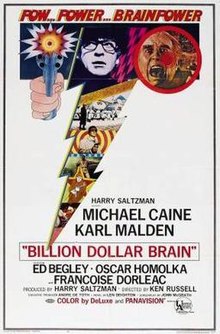
We watched the movie "Billion Dollar Brain" (a piece of Cold War over-the-top silliness from 1967 with Michael Caine as Harry Palmer; the "billion dollar brain" is a giant mainframe computer with probably less memory than your iPod -- my husband was laughing at the punch cards) over the weekend, and of course I was most struck by this:
Director Ken Russell is full of flourishes and Francoise Dorleac's cello playing is sub-par . . .I've been searching around all day, and cannot find out what was behind this. If anyone out there knows, please do tell.
Friday, September 3, 2010
I'm dancing as fast as I can

Wrong!
I do think there's a place for playing things fast. You need to do it to make sure fingerings work, to figure out what tempo you are aiming for, to get the flow and mood of the piece. But wow, one hour of slow practice is worth three of fast, at least. In fact, three hours of fast practice might even have a negative effect because you are simply playing from muscle memory without much intellectual involvement. Plus, you are often practicing mistakes, or glossing over any potential intepretive niceties that you might otherwise be able to add.
I can't even begin to recount all the times this has hit home. Most recently, my husband made the mistake of wandering into my practice room the other night, so I told him to sit down and listen to me play Bach. Talk about a shaky, messy, uneven train wreck. The prelude wasn't bad, actually, but the fugue fell apart completely. I did a lot of stopping and restarting and had to take a lot of running leaps to get over all the humps and make it to the end. And the thing is, I've been playing this through reasonably well for the past month, but having any audience brought my performance down to its true level.
I have been planning to schedule this piece for an AMSF recital soon, so this was a wake-up call to go back to the basics: small sections, fix stumbles by isolating them, hands separate, voices separate -- and all of this slow, slower, slowest. The metronome is my friend here. I've heard some people say they never practice with the metronome, but I think there's no better way to internalize a steady pulse. One's biological pulse is erratic and tends to speed up under stress, so it's not a reliable guide.
Further, I realized I've been pushing all of the pieces I'm working on, trying to play them up to tempo without preparing. What happens is my muscles can sort of do it, but there's not enough input from consciousness, so when something goes awry (a finger slips, I play a wrong note, etc.) I don't really know what I'm doing enough to stay with it. There's no real control.
This is of course a common problem. The difference in my case from the average amateur is that I do know how to avoid it; I've just been lazy while at the same time desperately wanting to just be able to play this stuff already, dammit. But there really are no shortcuts.
Subscribe to:
Posts (Atom)


