Tuesday, April 29, 2014

Reflections on a gig

There were some good and not so good things about playing with an orchestra at the Kennedy Center.

The best part was playing on a beautiful real stage, with plenty of room; good chairs, lighting, and sight lines (yes! I could see the conductor!); and no religious emblems on display (sorry if that offends anyone, but that stuff always makes me uncomfortable).

The level of playing was really good; it made me play better.

I liked the piece quite a bit -- though fairly simple, it is cleverly composed.

The not so good:

Despite my telling myself it did not matter in the least, I felt left out because I wasn't in a starring role. The level of playing here made me realize what I've gotten used to in my usual orchestra gig. So I've felt a bit down about it.

But there was a review in the Washington Post, with a picture! That's me, inside second stand:


Monday, April 21, 2014

Opportunity or exploitation?

I've made lots of mistakes in my musical life (let's not talk about my nonmusical life!). I've been offered playing opportunities that I turned down that probably would have been beneficial to me, and I've accepted others that turned out to be miserable and a waste of time.

At this stage, I frankly don't need whatever small amount of money I can earn doing random gigs, so whether something pays or not is beside the point. When asked to play somewhere now, I ask myself: Will this be fun, interesting, and/or challenging? Will I interact with new people who might prove to be stimulating in some way? Is it worth it just because it will get me out of the house?

I've recently had a few of these crop up, and after asking myself these questions I've accepted all of them. The first was a query from my piano teacher about playing at a school assembly with a couple of the faculty. The school is a small private school (what used to be called an "alternative" school), and the other musicians were amateurs with some musical training -- a trumpet player and a singer. Because (1) the request came from my teacher, whom I like very much; (2) it involved playing the piano in front of people, which is something I try to do as much as possible; and (3) the school is about a mile away from my house, I accepted immediately. We played a Handel aria, and it was fun to do. It was YouTubed:


The second is a concert at the Kennedy Center with an orchestra that plays a lot of tangos. I am playing only in once piece, a "Misa Tango" -- that is, a Catholic mass (Kyrie, Gloria, etc.) with music based on tangos. This will take place this coming Sunday. It sounds impressive to say "I'm playing at the Kennedy Center" but it actually can be a bit of a pain because of traffic, parking, and logistics. And sitting in the back of a cello section isn't my ideal. But something about this interested me.

Tango! Soul and Heart

And then I got an e-mail asking me to play principal in a string orchestra for this (click on the "Entertainment" tab):

Festa Italiana

The rehearsals are way out in Virginia somewhere, the music is difficult, and the pay is just a token. I mentioned it to a friend, saying it could be wacky but I'd know more after the first rehearsal, and he said "What part of 'exploitation' don't you understand?" But again, something about it interested me.

Finally, the amazing pianist Brian Ganz, whom I've mentioned here a few times, asked if I'd be interested in playing duos with a good friend of his who's an amateur pianist and a member of AMSF. She's even way-er out in Virginia than the string orchestra, though she's willing to drive to my house some of the time. But I like Brian, and she seems very nice, and I was able to answer "yes" to my three questions. We are going to work on some cello and piano duos and piano-four-hands music. It will be interesting to see how that works out.

This is all in addition to what I think of as my "personal" practicing. A lot to do … but certainly not boring.

Monday, April 7, 2014

Beethoven, finally

I played the Op. 90 Beethoven sonata this past weekend at an AMSF event, a small house concert. Aside from the six of us performing, there were only two people in the audience, one of them my husband, so it certainly wasn't a high-pressure situation.

Listening to it, I was not happy with the second movement; it was a bit too slow and way too clunky. The piano was a good one but balky, with a heavy touch and a stiff pedal, so in many places my pedaling didn't hold the notes I was intending to hold. One of the other performers turned pages for me, which was a big help, but because I'd never played the piece with a page turner before it threw me off a little as well.

The sonata is dedicated to Beethoven's friend, Count Moritz von Lichnowsky. From Wikipedia:
Unlike a typical sonata, this piece consists of two highly contrasting movements:
Mit Lebhaftigkeit und durchaus mit Empfindung und Ausdruck (With liveliness and with feeling and expression throughout)
Nicht zu geschwind und sehr singbar vorgetragen (Not too swiftly and conveyed in a singing manner) (cantabile)
The first movement is written in a 3/4 tempo, sounding mysteriously agitated and restless, described by Beethoven as "a contest between the head and heart," based on the situation of the Count deciding whether he should marry a young Viennese dancer. It starts out with powerful chords, responded by more subdued material. The falling semitone, particularly the G-F sharp, dominates the first and second subject groups, and most of the episodic work between.
The second movement, a rondo in the tonic major, however, quiets down into a beautiful melody with a 2/4 rhythm. The two contrasting movements suggest an agitated situation calmed by restful contentness. Notably, Beethoven uses German tempo marks for both movements.
English composer Bramwell Tovey characterized the movement as one "full of passionate and lonely energy." This contrasting gesticulation of emotion is especially evident in the piece's discernible dialogical form, where the head exposes an idea which is thereafter disputed by the heart.
Here is my performance. The sound level is unfortunately too low, so you may need to turn up your volume.

Beethoven, Sonata in E minor, Op. 90, complete

Tuesday, March 18, 2014

What I've been up to

I haven't posted much recently. I've been practicing the piano quite a bit because I have the pressure of weekly lessons, and I have the time, so why not? Although I feel I'm worrying too much about memorizing to the detriment of other things, like musicality and pianism.

What I find most difficult is maintaining concentration. I will be sitting there playing and realize my mind is a million miles away. The biggest problem with this is that when I finally get to perform something and both want and need to concentrate exclusively on what I'm doing, I can't because I haven't practiced that way. Duh. I think the key to dealing with this is to just stop when I notice this and refocus, as well as think about what I will concentrate on BEFORE I start playing -- stuff like bringing out the melodic line, security of fingering, knowing what is coming next, dynamics, articulating, pedaling, and on and on.

For some reason, this is less of a problem when I'm playing the cello. I think it's because my body is more involved. When you play the cello, you have to move your arms, and there is by the nature of the instrument physical follow-through on every note, whereas on the piano, it's possible to just sit there and zone out because you only need to do something physically at the beginning of each note.

My current roster of piano music is Beethoven Op. 90 (the complete sonata, two movements, which I am scheduled to perform at a house concert in a few weeks), Bach Partita No. 2 in C minor, Brahms Rhapsodies Op. 79 Nos. 1 and 2, and a prelude by Ruth Crawford [Seeger]. I also have not forgotten my WTC quest; I'm still fussing around with the C minor set from Book 1.

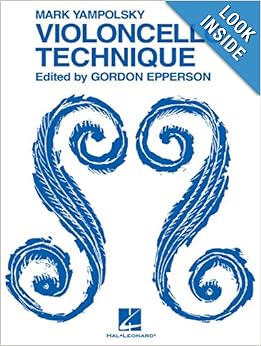
On the cello I'm trying to discipline myself to do a scale every time I practice using this book:


Each scale is set in a different rhythmic pattern with its own bowing and then is followed by arpeggios and various other technical exercises in the same key. Some of them are quite difficult (scales in sixths in four octaves, octave arpeggios in thumb position in four octaves, etc.). When I first acquired this book, I thought I needed to master each key before I went to the next, which proved an exercise in frustration. I like just working through one key on one day and then moving on.

I am also practicing Popper etudes. These are the 40 studies that have long been considered the centerpiece of cello technique. I am not sure that is really true, but they do offer many challenges and are also musically interesting. Since I have started teaching, I've become more interested in figuring out how to master technical issues as well as how to explain them, and it was bothering me that I never fully learned (up to a decent performance level) any of these etudes. So I've been working on No. 1, which is considered among the easier ones but certainly is not easy.

Then there's the Bach suite.

And here I sit typing when I could be practicing . . .

Saturday, February 22, 2014

Arts and crafts

I've been picking away at the Bach cello suite in E flat (No. 4). I learned and performed it years ago, though not very well, and I never was able to memorize it. The Prelude, in particular, is daunting, both because of the key and because so many of the phrases begin with the same arrangement of notes. 

As I was trying to figure out how to mark the music to help my memory, I came up with the idea of copying it and cutting up the score so each phrase is on a separate line. After a half hour with scissors and tape, this is how it looked:


My crummy cell phone pictures may not show that I also numbered the phrases (there are 19 -- purely based on my instinct rather than any deep analysis). I found it interesting that the number of measures in each phrase varies from eight to two. Though of course they vary in length; otherwise, the piece would be pretty boring, right?

This does make it seem more manageable, so we shall see! I can already play each phrase from memory; now the task is being able to string them together.

Sunday, January 19, 2014

In the interests of honesty ...

My performance of the Brahms Rhapsody today was, um, kinda bad.

The only sort of good part, other than the fact that I got up there and played without stopping until I got to the end, is that I didn't rush excessively. But I missed so many notes, and I made mistakes in places I've never made them before. Also, I thought it all sounded blah, without enough contrast in dynamics or sense of melodic line or emotional involvement. Double ugh. I did play it much, much better at home, and even the last time I played it at my piano lesson. Very disconcerting (ha).

So the sole relic of the occasion I'm going to share here is a still from the video:


Friday, January 17, 2014

Pressure!

So I performed the Bach movement this past Sunday, and I will be performing the Brahms Rhapsody (Op. 79 No. 1) this Sunday. And then at my piano lesson this week, my teacher urged me to sign up to play the Beethoven sonata I'm working on (Op. 90, in E minor) in April at an AMSF "Sonata" recital (designed so people can play longer works), which I have just done. I think he can see I operate better when I have a specific goal, but this feels scary for some reason. When I thought through it, though, I realized I have almost three months to practice the piece, so I should be able to do it. It's not like it's the Hammerklavier or the Waldstein. It does have its moments, however.

There's a pleasant recording of the piece here on IMSLP (hard to believe the pianist is 90 years old!):

Piano Sonata No. 27, Op. 90, performed by Randolph Hokanson