Showing posts with label Instruments. Show all posts

Friday, December 26, 2014

Strange turns


A couple of weeks ago, I was perusing Facebook and saw a post by one of my FB friends about a meeting of a local group that gets together to play the viola da gamba. It was featured on one of our local NPR stations:

Local Viol Fans Stay Loyal

The viola da gamba is something like a guitar, in that it has six (or seven) strings and frets, but it has a curved bridge and is played with a bow. It is played somewhat like a cello, in that it is held on the legs (where the "gamba" part comes from, Italian for "leg") in a vertical position. It is made in a a range of sizes (as depicted in the illustration above). Once the violin became popular, in the late 17th century, the viol became virtually obsolete. It has continued to be played and listened to by people interested in antiquities but for the most part not by mainstream musicians or audiences (with some exceptions, most notably Bach's three sonatas for viola da gamba and harpsichord).

Anyway, something about this stirred a desire I didn't know I had: I wanted to play one of those things. So I messaged the guy who posted the story -- he teaches both Baroque cello and viol -- and asked how I would go about getting started, and he offered to lend me an instrument. The upshot was that within a week I was sitting in his studio having a lesson on the bass viola da gamba. He sent me home with the loaner and a beginner's book.

A couple of days later, I was searching around on the 'net for info about viols and somehow came across an auction listing: an estate sale that included a lot of three violas da gamba, with bows, plus a pile of music and some extra strings. They were made in the 1970s by an amateur who had taken up violin making after he retired from his job as an engineer.

In an normal state of mind, I would be leery of this sort of thing, but I was apparently not in a normal state of mind because I soon found myself bidding. I didn't even notice until after I had made my non-rescindable bid that they were described as "tenor, alto, and treble" -- when what I really wanted was a bass.

The auction was set to end the next evening, and I spent the interim beating myself up mentally over being so stupid and hoping someone else would outbid me. There was one other person who bid a few more times, but I had craftily bid the highest amount I could imagine wanting to pay, so my bid automatically increased after each of his bids. I guess he hit his limit because at the close of the auction I was the proud (?) winner.

I went to pick them up the next day. I had no idea what to expect.

The pickup location turned out to be a modest retirement community, rows of plain one-story buildings spread out like caterpillars. I parked my car and proceeded down the row I'd been directed to; the door of the house was open, and I was greeted by a pleasant young couple who were handling the sale out of the owner's emptied-out place.

I was feeling fairly grim about the whole thing at that point, but they seemed so excited about it that I agreed to look at one of the instruments before I took them. They unzipped the largest case, and yep, it looked pretty darned amateurish: shiny red varnish, a very crudely carved face in place of the scroll. I don't remember what I said, but their enthusiasm made me feel a little better. The guy helped me carry all the stuff to my car, and I drove home.

After I had sorted through all the music and examined all the instruments, I realized that the largest one was actually a bass (what I had wanted in the first place), the middle one a tenor, and the smallest one (about the size of a violin) a treble -- the usual members of a consort. The treble's sound post was down, so I couldn't do anything with it, but after I replaced a broken string on the bass and tuned it and the tenor up, I realized that yes, these were playable and not totally terrible, especially for the price I paid. The music alone would have cost several hundred dollars, the strings another several hundred. I started to feel a little happier about my purchase. And then, I'm a sucker for instruments in general. So I guess these little guys will entertain me for a while.

"Christmas gambarama"

I did promise my husband not to make a habit of this.

Monday, October 6, 2014

Cello Tales

I have a video recommendation -- this documentary:

Cello Tales

The blurb at the above link:
Four strings, a wooden box that has lived for 300 years.
The cello is the most human-like of all musical instruments in shape, size and sound.
A daughter searches for her father's stolen instrument for a decade. An artisan looks for the best way to craft the perfect piece of wood. A soloist travels the world playing. A copyist recreates the sound of the great masters.
The cello. More than just a musical instrument.
It's about an hour and a quarter, mostly in German, with English subtitles. I didn't try to download it and just watched online.

It's both educational and nicely done, with some good music. It approaches the "cello mystique" in a non-mystical way, which I liked very much.

Monday, October 15, 2012

What Makes It Great? (Could it be the pianist?)

Yesterday, my husband and I went to a performance by the music appreciation guru Rob Kapilow. I've heard him on the radio (and if you're a public radio listener, you probably have, too) and have found his comments solid and insightful, but the main reason I wanted to attend this particular show was because the topic was Chopin's piano music and the performer was my friend Brian Ganz.

Here's the blurb from the Washington Performing Arts Society website:
In his acclaimed What Makes It Great? series, former NPR music commentator Rob Kapilow "gets audiences in tune with classical music at a deeper level than many of them thought possible"(Los Angeles Times). In a three-part format, Kapilow unravels and explores a great musical masterpiece with the audience. Next, the piece is performed in its entirety followed by a Q & A with the audience and performers.

"Not since Leonard Bernstein has classical music had a combination salesman-teacher as irresistible as Kapilow." ~ Kansas City Star

The performance at Baird Auditorium, in the Smithsonian Museum of Natural History, was sold out, and the place was packed, so we ended up sitting in the front row. I normally do not like doing this, but in this case, I enjoyed the more visceral experience of the piano's sonorities.

The pieces discussed and performed were two Mazurkas (Op. 7, No. 1, in B flat major, and Op. 17, No. 4, in A minor), a Nocturne (Op. 62, No. 1, in B major), and a Polonaise (Op. 53, in A flat major). A Steinway concert grand and a Yamaha digital piano were set up on the stage. Brian sat at the Steinway and Kapilow sat at the Yamaha, and as Kapilow discussed the pieces, he demonstrated a bit and Brian demonstrated a bit. After each discussion, Kapilow left the stage and Brian performed the work in full.

As to what makes this music great, I'm probably too close to the material to get a sense of whether this was conveyed in such a presentation. My husband, as a nonmusician, said he appreciated the way Kapilow took each piece apart, discussing first each form (what a mazurka is, etc.) and then how Chopin used harmony and melodic structure to create his effects. Kapilow certainly touched on all the important points: Chopin's ability to take small salon forms and embue them with color, interest, and imagination; his individualism (eschewing the large forms, like symphonies and operas, to focus on his strengths as a composer); and the technical challenges of playing this music. But Brian's wonderful performances were additionally persuasive.

As I mentioned earlier this year, Brian is engaged in a multiyear series of concerts, the Chopin Project, in which he is performing all of Chopin's music, so he has been immersed in this music, and it shows. I can't remember hearing such beautifully clean, yet relaxed and powerful, versions of these pieces.

Sunday, May 27, 2012

Action shot

My husband took this picture today.


You might notice my (relatively) new toy here. I had wanted a Luis and Clark carbon fiber cello ever since I heard about them more than 10 years ago, but I had no real reason to get one. Yo Yo Ma has been famously featured in their ads:


Earlier this year, a friend of mine was selling his and made me an offer I couldn't refuse (well, I could have refused it, but it was just too good to pass up). So it's mine now, despite my desire to simplify my life and have less stuff.

It's very fun to play. The smooth carbon fiber fingerboard makes shifts really easy, the size and shape make it especially comfortable to hold, and it's lively and responsive as well as being extremely resonant. My only problem with the sound is that it has a slightly buzzy edge to it that is a bit unpleasant under the ear. I seriously considered using it for the concert next week when I play the Tchaikovsky Pezzo Capriccioso, but that sound quality dissuaded me. I simply did not have enough time to experiment, so I am playing it safe by using my wood cello.

Here's a quickie recording I made with this cello of a Bach Allemande a few months ago:

Bach: Allemande in G major from Suite No. 1

I was practicing on it today because I'm going to use it for a coffee house gig I'm playing with my folk group this evening. I figure it will at least save me some playing fatigue, and it will also be a conversation piece if nothing else.

Saturday, April 7, 2012

Soul surgery

I bought my cello new 10 years ago. It had a warm, full, mellow tone and was even from bottom to top. I could play an open A and not have that characteristic piercing whine that is a tendency for that string on the cello -- any cellists out there will know what I'm talking about. Over the past year, I've felt the cello wasn't sounding its best and knew I should take it in to a shop to get looked at but kept putting it off, thinking I just needed new strings, like that visit to the doctor when you think maybe you only need vitamins or some cortisone cream but want to know for sure.

Also, I am bad with hardware type things. I don't seem to have an instinctive ability to grasp technical issues in relation to the eventual outcomes. When I have to choose an appliance or gadget or other object, it's hard for me to sort out these issues, and I dread falling into the hands of an incompetent or unscrupulous salesperson because I can't explain exactly what I want. In this case, I feared getting my cello messed up.

But there is a shop I have some confidence in, so I finally took the plunge last week and took the cello over there. After five minutes in the back room with the luthier, the assistant brought the cello out to me and gave me the diagnosis. He said everything was fine EXCEPT for the fact that the soundpost was too tight, and was actually pressing the wood of the top out in a little bump I could feel when it was pointed out to me. What had caused this? Perhaps settling, perhaps the wood drying out a bit and shrinking. I would suspect this last might be the reason because the wood was probably not aged as long as it could be before the cello was made, given that this was an inexpensive student-level cello.

In any case, they recommended replacing the soundpost. When I asked about  new strings, they said things might change with a new post, so they would rather wait until the post was in and I could try the cello, and then work on which strings would be best.

A soundpost, for those who don't know, is a little wooden dowel that is inserted into the instrument through an f-hole and wedged between the top and the back, and it serves to transmit the vibrations from the top to the back and amplify the sound, so shaping and placing it is a very important bit of luthiery. In fact, according Wikipedia,
The sound post is sometimes referred to as the âme, a French word meaning "soul". . . . The Italians use the same term, anima, for this. 
I had to leave the cello there for several days. When I went to pick it up earlier this week, instead of this being a simple matter of whipping out my credit card, I ended up spending about two hours working on adjustments. My first reaction was not happy -- the A sounded biting and harsh. The luthier moved the new soundpost a bit -- and it sounded worse! Moved it a bit more -- sounded horrible! So he put it back where it was at first and we moved on to choosing strings.

After years of buying strings hit or miss over the Internet, it was a luxury to be able to hear some different strings without having to commit to them -- well worth the higher price I had to pay for my eventual choices because I was buying in a full-service store. We quickly decided on the same type I have been using for the G and C (Obligato). But the A was a problem, and the D would be affected by the A. We started with a Larsen, then tried a Kaplan, then an Obligato, then a Dominant (yuck on that one! sounded like a piece of tin). The Larsen ultimately was best, and to go with that, the Obligato D was good.

I still wasn't 100% bowled over. It was like seeing a loved one after surgery -- yes, there he is, but he looks weird. So yes, this was my cello, but it sounded weird to me.

However, when I got up the nerve to get it out at home that evening, I started enjoying the sound. It definitely is different than it was when new; it's a bit brighter and more open, but it has some depth and power. It has lost its childhood softness and has more edge.

That's life, I guess; as soon as you get used to something, it changes.

The patient, resting comfortably.

Wednesday, November 2, 2011

Speaking of Carnegie Hall . . .

Though they weren't terribly interested in music per se, my parents tried to instill interest in and respect for the world of classical music in me and my sisters. It's actually a rather interesting case study of nature versus nurture: Out of five girls raised in the same family and environment, only one (me) developed an interest in it. None of the others even listens to the stuff, let alone plays an instrument. One of my sisters went a bit farther with the piano than the others, and even bought a spinet and gave a few lessons to some neighbors' children when she was a newlywed, but that was many years ago, with the piano long gone. I don't believe she listens to much in the way of music, though she does attend some of my concerts in a show of family solidarity. (She doesn't read this blog, though!)

So when I was growing up, we had a small and tattered collection of records in the house, including some albums of Broadway show tunes, a few random classical recordings, and a set of Great Classics purchased one per month at the A&P. We also had some aimed at children, including a set of Singing Science records and one that had a James Thurber story on one side and this on the other:


I do remember that this was the flip side of the other recording, and I do not remember this album cover. In fact, I don't remember that this was the name of the story, so perhaps what we had some sort of reissue of the original 1948 version you see here. In any case, it was played to death in our house and was finally discarded at some point.

This story has it all: unctious, cheerful male narrator; slightly wry and ironic tone; culture and humor; pathos and a happy ending; and piano music! It's a life in music told from the piano's point of view.

For years, I have been wondering if I could find a copy of it, and now I have, thanks to the folks who set up this site:
 Kiddie Records Weekly began in 2005 as a one year project dedicated to celebrating the golden age of children's records. This period roughly spanned from the mid forties through the early fifties and produced a wealth of all-time classics. Many of these recordings were extravagant Hollywood productions and featured big time celebrities and composers. Over time these forgotten treasures slipped off the radar and it has become our mission to give them a new lease on life by sharing them with today's generation of online listeners.

And here it is, in all its crackly glory (but without the big scratch that made it skip near the end on our family's copy):
If you click on the link, you can listen to the mp3 and/or download the file and images. The pianist on the record, Frank Glazer, is still alive, btw, now 96 years old, still playing and teaching.

Wednesday, July 27, 2011

The vacationing musician

I'm not accustomed to taking time off from everything and going somewhere for no other reason than to go there, but that is what I have been doing for the past 10 days. My husband had to drag me kicking and screaming from all my Stuff -- piano, cello, kitties, garden, sewing (though note that I did not include "work" in that list) -- for a trip to Barcelona. It took me at least four days after we arrived to unwind enough to start enjoying not having to do anything more than figure out where to eat next.

I had thought that maybe I could find a piano or two along the way, but it wasn't meant to be. Our hotel happened to be a few blocks from a music school (Esmuc), so I went over there the first morning and (figuratively speaking) pressed my nose against the window, but the young woman at the front desk said no, I couldn't rent, borrow, or otherwise use one of their practice rooms unless I was enrolled at the school. Perhaps if I'd had a name to drop it would have gotten me in there, but I just gave up. However, I did take a trip through a nice museum in the same building featuring an exhibit about the history of western music, with instruments of all kinds beautifully displayed (read more about it here: Museu de la Musica).


They also had an exhibit that was a sort of petting zoo for a handful of instruments, one of which was a cello, but when I tried to play it found that no one had rosined the bow recently so it was impossible to get a sound out of it. Maybe someone on the staff had sneaked in there and greased the thing after hearing one too many children sawing away.


Note: This is not a picture of me. I nicked the link from the museum's website.

As our time there progressed, I felt my identity as a musician seeping away a bit, not altogether a bad thing. But I dreaded that feeling you get when you eventually try to play again, when the first touch of the instrument is bizarre because you know what you are supposed to do, but it feels like a distant memory at best. We returned yesterday evening, and with trepidation I sat down at the piano -- but it wasn't so bad. I played the C major Bach prelude from WTC I and then Chopin's B major nocturne, and then I decided to quit while I was ahead (i.e., before I fell over from jet lag).

Thursday, October 7, 2010

Music in Maine

This past weekend we finally made it to Maine. The original plan, two years ago, was for three of us (the three women who are in our neighborhood folk-ish band) to travel there to play with an accordion player the recorder player has known for 30+ years. He used to live in this area and retired about five years ago to Maine. But then the violinist had a family emergency and couldn't go, and we canceled it.

In the middle of last week, the violinist came down with something, and she still didn't feel good by Friday, so she again ended up not going. But because our spouses were coming along and we were all looking at it as more of a general vacation than an all-music kind of thing, we forged ahead this time.

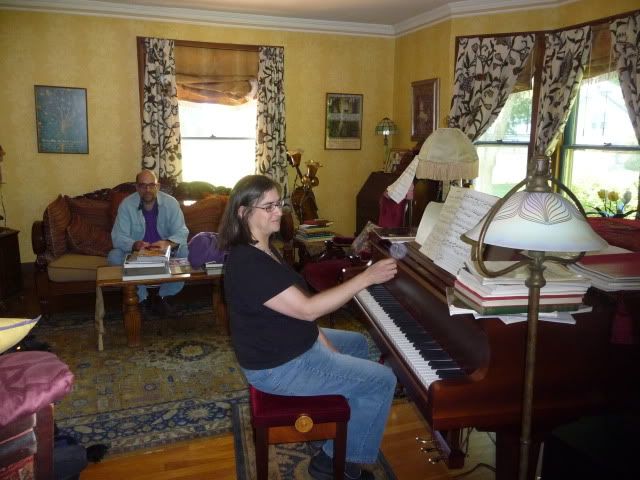
Part of the deal was that I had to pick up a rental cello on the way from the airport, so each couple rented a car and drove separately. One of my imaginary friends from the Internet lives sort of on the way, so we decided to stop in and see her and her husband. I was totally zonked from getting up at 5:00 that morning, but we had a nice visit, and I played a little on her Seiler grand.


(That's my husband sitting on the couch in the background.)

She also has a fractional-sized cello (maybe a three-quarter-sized one?) that she wanted me to check out -- her husband picked it up for her on a whim from a pawn shop years ago. It is not bad sounding but needs new strings and some tweaking. (It was tuned a half step flat, and I was afraid to tune it up because the strings looked like they were about to pop.)

Back on the road, we headed for Glen Cove and Woodsound Studio, a nice little shop that services and sells mostly stringed instruments, with a few folk-oriented ones as well. They gave me a very good-sounding Romanian-made student cello, and judging from the way the cello was set up, they know what they're doing.

We then continued on to Southwest Harbor. Our B&B faced a picturesque tree-lined street, and from the back of the house, you can see the water. After a quick dinner at one of the restaurants up the street, we went down to the basement of the B&B for the first of what turned out to be only two sessions with the accordion player. He was really busy and couldn't give us much time. We played through some of our repertoire for about an hour, and then he had to leave. So that was Saturday.

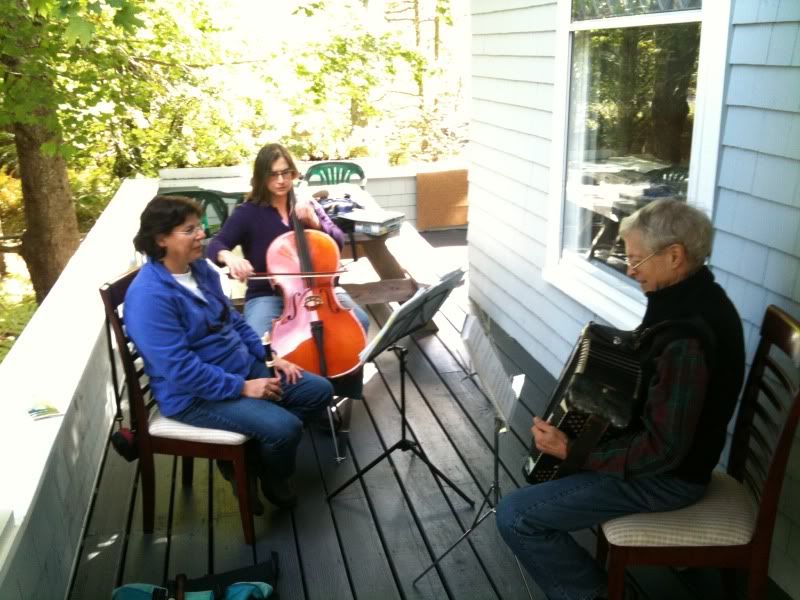
We met again on Sunday morning for about two hours. We decided to liberate ourselves from the dark basement room and started out playing outside on one of the porches:

However, it was really too cold to play outside, so we moved indoors and played while the cleaning person and other guests picked their way around us.

It was bothering me that I'd rented this cello to play it for only three hours, so on Monday evening, I suggested to the recorder player that we play as a duo. She asked our hosts at the B&B if it would be okay, and they got excited and asked if we'd like to entertain the other guests at an impromptu cocktail party. So while they shook up some Cosmopolitans and set out dishes of tapenade, we set up in the dining room and played for a while -- quite a bit different without a rhythm instrument, but it wasn't too bad. We wound up our session and then drove down the road to visit the accordionist's wife (he had had to go out of town that morning, but she invited us over for a short visit). It turns out that she was a music major at Wellesley back in the day, though she doesn't play much now. She has a baby grand piano -- a Hardman -- and she asked me to play a bit. So I played my Bach prelude and Brahms Op. 118 No. 2 (the latter with a big brainfart hole at the end, unfortunately; I wonder why that happens?).

The rest of the time, we did vacationer-type things like going on hikes and eating seafood. The weather was beautiful, aside from a little rain on Monday morning.

It was a pleasant trip, and I liked getting in some playing (I always feel better when I can play music), though renting the cello was a bit of a pain. I suppose I could have bought a seat for my own cello on the plane, but that is always an iffy proposition (sometimes the airport people won't let you bring it on board if the flight is crowded), and then I'd have had to worry about it the entire time. I've done my share of traveling with a cello, and it's a hassle however you arrange it.

If money were no object, I'd get one of these: That Carbon Fiber Cello

But with my traveling-with-cello career as limited as it is at the moment, I can't justify it.

Sunday, August 8, 2010

Electric Land

I mentioned in an earlier post that one of the problems with playing the cello is that it's not the most portable instrument. Though you can pick it up with one hand and carry it from place to place without too much difficulty, it's bulky and awkward, and it's really very fragile -- one wrong turn, and you can knock a hole through it, slam it in a door, tip it over and watch it go crashing to the ground. Traveling on public transportation can be something of a nightmare, or at least expensive (when you have to buy a seat for it).

About 30 years ago, I was in an airport somewhere with my cello, and a man came up to me and asked if I'd be interested in a cello you could fold up. As a matter of fact, I told him, I'd played on one once and hadn't liked it. Well, it turned out that that man was Ernest Nussbaum, the inventor of the one I'd tried, something called the Travielo. It was basically a fingerboard, strings, and bridge mounted onto a wooden frame, fitted with a pickup and primitive amplifier. The whole thing could be dismantled and put into a small wooden box within five minutes.

About a month ago, NPR did a story about Nussbaum and the current incarnation of this instrument, the Prakticello. It's similar to the one I played on all those years ago, but minus the electronics.

You can read about it/listen here:

Cello in a Box


Shortly after this story was broadcast, we decided to go on the trip to Maine that I mentioned last week, and that started me thinking about the possibility of acquiring a cello for travel. Although I am kind of a Luddite, I'm not a purist. I'm not against something that serves a useful purpose. My main interest is in portability, but in addition, if I ever get into playing more nonclassical music, the possibility for amplification would be nice.

Any cello can be electrified with a pickup and amplifier, but those designed to be electric have certain features that are appealing from a portability standpoint. Electric cellos are much smaller than traditional acoustic cellos because they don't have the large resonating body; they are generally just simple sticks, with a fingerboard and bridge on the front and electronics in the back. They incorporate various design elements that are either practical (to provide the traditional contact points -- chest, left hand, and knees) or aesthetic (cool-o rock band shapes and colors).

I've spent some time searching the Internet for information and opinions, but nothing beats actually holding the instrument in your hands, so I searched out some local options. First, I emailed the creator of the Prakticello, Ernest Nussbaum, and asked if I could arrange to try one out. He said he would have one available soon and promised to call me when it was ready.

Yesterday I made a trip to Chuck Levin's. They carry two brands: one made by NS Design and one made by Yamaha. Each has several variations to choose from. NS Design cellos are available in four-, five-, and six-string versions but with the same body design; Yamaha offers different body designs, all with four strings.

The salesman showed me a five-string NS Design cello and the most basic Yamaha model, SVC-50. I went in with high hopes for the NS Design cello: it's very attractive, made out of a solid piece of maple with a sort of folky look to it. Here's the five-string model:
It's designed so you can play it standing up, either on a heavy metal stand (which is included) or on a strap around your shoulders like a guitar, or sitting down. The stand can be adjusted for the seated position. There is also an optional endpin, but they didn't seem to have one in the store. My assessment, albeit based only on noodling on it for 10 minutes: nice sound, weird and uncomfortable playing position. The fingerboard feels very short, and the only stand-in for the shoulder on the left side of the cello that provides a reference point for shifting out of first position is a small metal nub on the back of the neck. I think it would be hard to go back and forth between this and my acoustic cello. There wasn't a four-string model for me to try, either, so I don't know if that might feel a little more natural. It's also heavy, especially with the stand.

The Yamaha model I tried is very plain. It looks kind of like a giant praying mantis.


But as you can see, the playing position is natural and the proportions of the instrument are the same as an acoustic cello. I liked this instrument a lot -- its simplicity, its design, and its clean sound. It's also very lightweight, at about seven pounds. The knee contact piece just screws on, and it's easy to install and remove. Yamaha calls it a "silent" cello, but it actually has a pleasant, though soft, acoustic sound when not plugged in.

Ernest Nussbaum had called me Friday evening to tell me the cello was ready, so my husband and I went to his house this morning. He had the cello waiting for me in his study. I was able to pick it up and start playing it, with virtually no adjustment other than the one you normally would have for a different cello. It has a similar acoustic sound to the Yamaha, though perhaps more resonant.

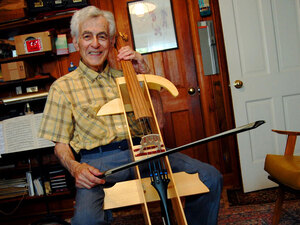
Here's Nussbaum with his invention (photo from the NPR story):


Here's moi, from this morning:


This cello has the best portability of all of them. It doesn't have any built-in electrical components -- Nussbaum said he gave up on that when it became apparent that the main utility for this instrument was as a practice cello when traveling or when living in close quarters with other people whom you do not want to disturb. However, one could easily use a pickup and plug that into an amp, just like one of the electric designs.

And the amp is the rub: if you want to use one of these cellos for performing or rehearsing, you need an amplifier, and they are complicated and expensive. The cello may only weigh 7 pounds, but add a 22-pound amp and you're getting back up to the weight of an acoustic cello (though at least it's not all in one awkward, fragile package). I looked at some at the store yesterday, but they are in a different department than the band and orchestra instruments, and they didn't offer to let me play the cello with one.  So although there was a big heavy amp in the room with the cellos, I wasn't able to find out how it would actually sound with something more like what I would want to buy. I did play the Yamaha for a minute with headphones, but I can't see myself using headphones much.

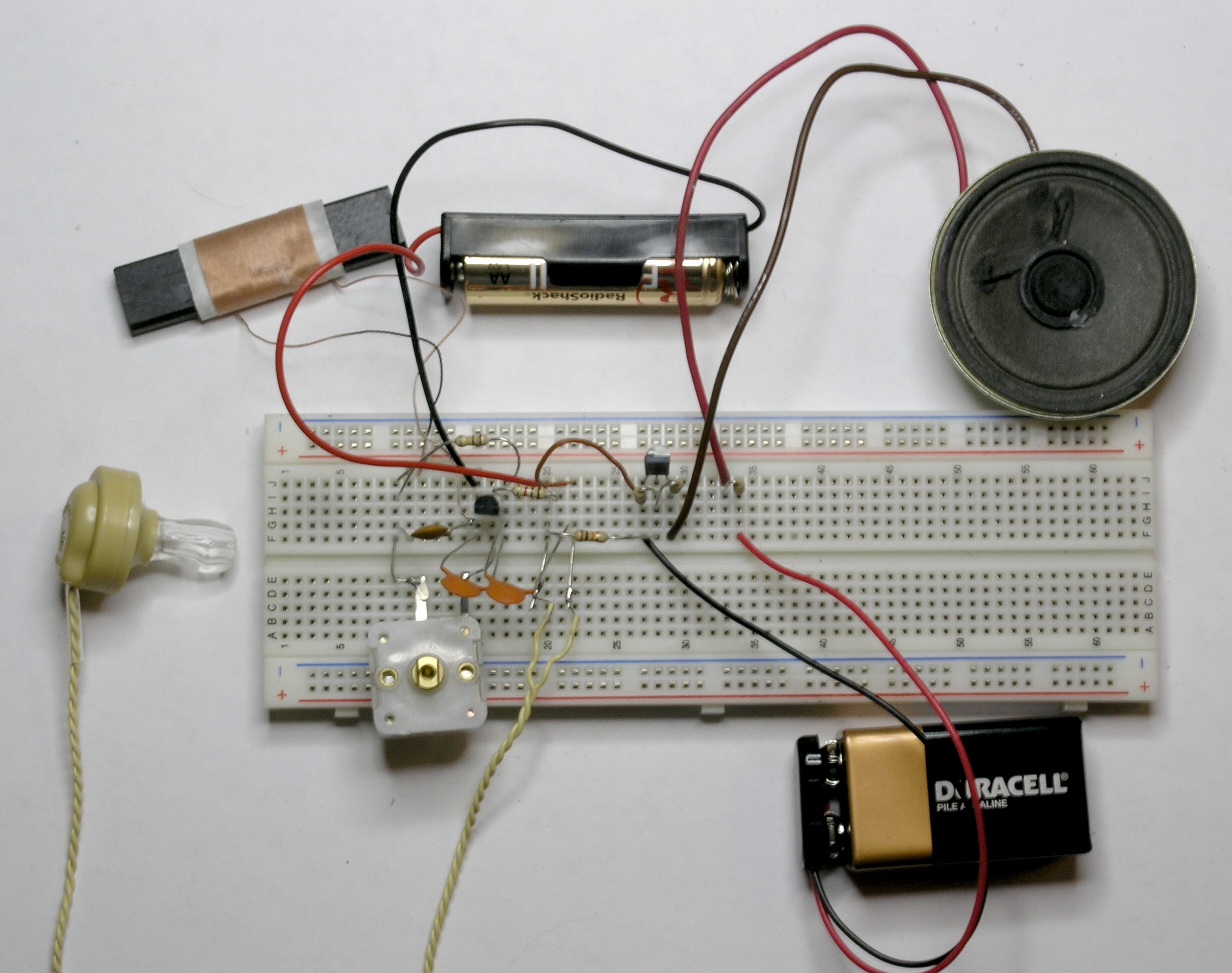
While we were at his house this morning, Nussbaum showed us an old Travielo he has, and he explained that he made the amplifier himself -- just a little thing, with no container -- because he couldn't find anything else that would work at the time. I didn't get a really close look at it, but I believe it was something along these lines:

Image from this site: http://sci-toys.com/scitoys/scitoys/computers/solderless/amplifier.html

He claimed that one would need only 1 watt for most purposes for this instrument (something like what's in the picture here), but I wonder about that. I'm not planning on playing Flight of the Bumblebee with a heavy metal band any time soon, but I'm thinking at least a little more power than that might be necessary.


In any case, I've got a few things to think about here.

Thursday, August 5, 2010

What I'm playing this week

On the piano:

Bach, WTC I/19 in A major: Still struggling along with this one, especially the fugue. I know I'm practicing it too fast and in chunks that are too long. I'm also straining something in my hands, which is really not good. The solution is obviously to SLOW DOWN, pay attention to what my hands are doing (am I using good fingering so that I'm not stretching unnecessarily? is everything relaxed?), break down into smaller sections, and SLOW DOWN.

Brahms Op. 118:
No. 3, Ballade: I'm making good progress on this. I have all of it memorized and am working on getting it faster and cleaner.
Nos. 4-6: I'm dipping a bit into each of these. They seem so much less difficult than they did even six months ago (though of course not easy).

Beethoven, Op. 2 No. 3: This is another piece for which it would behoove me to SLOW DOWN and practice in smaller sections. But it is not nearly as difficult as the Bach or the Brahms pieces I'm working on.

The past couple of weeks I've been making a conscious effort to simply increase my practice time whenever possible, and it definitely helps. I'm still considering pursuing the school thing, but before I do, I want to see if I can actually practice at least three hours a day more than every once in a while. So far, I have not been able to do so, which makes me wonder if I'm really up to this.

Yes, quality time is important in practicing, but amount of time is also important, especially if you are learning new skills. Experienced musicians who are just maintaining do not need to practice that much, but even they, faced with learning new music, need to increase the hours they spend.

On the cello:

The cello has been getting an extended rest this summer. I finally dusted it off this week and creakily played through a few things. It wasn't too terrible, and it actually felt good physically: playing the cello seemed to smooth out some of the strain I was feeling in my hands from the three Bs I've been struggling with on the piano.

A few things on the horizon for the cello:

A reunion concert with the DC Youth Orchestra. This year is the 50th anniversary of the program, and they contacted a lot of the former members about playing in this. It will be at the Kennedy Center in the Concert Hall on August 21. I agreed to do it, and the concert itself is fine with me (in fact, I'm looking forward to playing -- there are many excellent musicians who will be participating), but getting to and from the Kennedy Center with my cello is going to be a pain.

The first TCO concert is in September this year! It seems so early. They decided to redo the schedule to avoid having a concert in January when the weather is usually the worst we have here. So concerts will be in September, November, April, and June. I have no solos this year, though, so not much pressure.

A jaunt to Maine this fall with the ladies from my neighborhood band, to visit a friend who used to play accordion in the big folk group that we have all played in. He took early retirement and moved up there about ten years ago, and one of our group who has known him for a long time has been wanting to go up and visit him and play music with him. This is all fine, though again, there is the problem of what to do about a cello. I'm not buying a seat for mine on the plane for such a short trip; there's always a question of whether they will even let it on board (which, no matter the formal policy, is left to the discretion of the person guarding the boarding gate, who has the authority to summarily banish a cello to the baggage compartment). Driving up there is not an option. So I'm looking into others(portable electric cello? rent a cello there? find one to borrow?).

Anyway, that's what's been happening. Somehow the summer is flying by. But I am making some music every day.

Sunday, July 4, 2010

Instrument comparison: Piano versus cello versus . . .

I've been thinking lately about the differences between playing the piano and playing the cello (as my poor cello sits in a corner while I practice the piano). I came up with a list of my pros and cons:

Piano vs. cello:
  • It's a complete experience -- I do not need to depend on anyone else to play something. Think about it: On an instrument like the cello, you can spend years learning a piece, but then when you are actually preparing to perform it, you get what amounts to a few hours to coordinate with an accompanist, orchestra, or ensemble, and you are pretty much dependent on their level of expertise for the final result.
  • Vast choice of music (Chopin!). A lot of music has been written for the cello, but the literature is miniscule compared with what is available for the piano. Hundreds of pieces by Bach alone! And a large proportion of the piano literature is iconic, containing many monuments to civilization, or at least to Western art music.
  • Much more intellectually challenging. Even for the simplest piece or improvisation, the pianist needs to understand harmony and voicing (emphasizing one line more than the others). When you get into a four-voice fugue, or the thick chromatic harmonies of the Romantics, there is a world of mastery to challenge you. To really play a piece well, you need to memorize it (even if you don't ultimately perform from memory), and memorizing all this complexity takes you to a seriously higher level of mental acrobatics than memorizing anything on the cello.
  • Don't have to carry it around. You would be surprised how limiting the cello's size is on a day-to-day basis. It's small enough to carry, but too large and heavy to just sling on your back. If you want to travel with it, you either have to drive or buy a seat for it on the public transportation of your choice. It's not so easy to just take it to work for an evening rehearsal, so I always end up taking time off to go home and pick it up, or having to come up with complicated plans so I can get from Point A to Point B with the darned thing.
  • Preparation for playing is easy: Just sit down! For the cello, you have to get it out of the case, tune it, find a chair, make sure your endpin doesn't slip, get your music stand situated (and if you're using one in a concert, figure out where to place it so you can see the music but it doesn't get in the way; one of my cello teachers called the music stand "the fig leaf").
Cello vs. piano:
  • Does not require as much practice time. This makes it an excellent instrument for an amateur musician. Now of course, you could spend endless hours on it, but for even above average competence, the minimum necessary practice time is  much less than what you have to spend on the piano.
  • More of a social experience (because it does require collaboration). This is really good from a reality-check standpoint. I know I tend to get twisted up in knots about my playing when I don't have any interactions with the outside world. When I'm practicing the piano and don't play for anyone else or get any feedback, I can either under- or overestimate how I'm doing. When I play the cello in a chamber group, or even in an orchestra, I get an instant reality check both in terms of what I'm hearing and reactions of the other players. There is also a "greater than the sum of its parts" effect: In good circumstances, all of those human brains working toward the same thing can create a better musical experience than just your lone brain.
  • More directly expressive -- you actually touch the strings and feel them vibrate. You really do feel more like you are singing and like the instrument is part of you than when playing the piano, which tends toward the percussive and mechanical (though it doesn't have to, of course).
  • Always perform on the instrument you practiced on (as opposed to the piano, when you generally do not). This is something that gives you more control over what comes out at a concert.
  • You can tune it and do basic maintenance (change strings, adjust the bridge) yourself. With the piano, even when playing on your own instrument at home, you are somewhat at the mercy of piano technicians and tuners.
I think this covers the basics, at least in terms of my opinions. I'd be curious to know if any readers out there have thoughts on this.

For fellow statesiders, I hope you're enjoying the holiday today! 

Sunday, May 30, 2010

Pianos and piano people

Yesterday, after a quick rehearsal of the Milhaud that I'm playing with the chamber orchestra I'm in, my husband and I jumped in the car and drove up to Philadelphia for an afternoon and evening of playing pianos and talking about music and many other things with a group of people I've gotten to know from several piano-related internet forums. We gathered at the Cunningham Piano Company showroom in the Germantown neighborhood, which is full of historic sites and buildings dating to the 17th century.

The first event was a lecture by Indrek Laul, the president of the current incarnation of Estonia Pianos. Unfortunately, because of the aforementioned rehearsal combined with holiday traffic, we arrived just at the tail end of his talk, which I am sorry to have missed. I have met Laul a few times but have never heard him speak at length, or play the piano. We were at least in time for a sandwich lunch buffet generously provided by Rich Galassani, proprietor of Cunningham. After lunch, we watched an energetic presentation by pianist Hugh Sung, who has a lot of irons in the fire related to using new technologies for playing and teaching the piano (which you can read about at the link I've provided).

Rich gave us a tour of Cunningham's workshop, in a separate building, where they rebuild and repair pianos of all sorts. Both of the Cunningham buildings are old and interesting, with large rooms, high ceilings, and worn wood floors. This narrated slide show created by the Philadelphia Inquirer provides an accurate portrayal of what we saw yesterday:

Cunningham Pianos slide show

The rest of the afternoon was taken up with impromptu performances by the attendees, ranging from a full-fledged reading by Joe Kubera of a piece written in the 1990s (I didn't note down the name of the composer, but we all gathered around the piano and watched the score as he played, which was interesting) to scattered attempts by the rest of us to recall once-known pieces. All were met with friendly approval. Rich had asked me to bring my cello, but I decided against it after I weighed the logistics of hauling it around against the probably short time I would be playing it, adding in the element of not really having anything ready that would fit in with the piano-centric occasion.

These piano parties (I've been to about a half dozen of them since I've been involved with the online communities) are really a good way to get a taste of performing without having too much riding on it. It's especially fun at a place like Cunningham's, when there are multiple good pianos to choose from. Because of Laul's presentation, an Estonia 190 that is identical to the one we have in our house was impeccably tuned and set up in performance position, so that was the piano everyone played on. It was somehow gratifying to hear how good it sounded and how much everyone liked it. We also spread out and tested most of the other pianos on display, including several digitals (a digital harpsichord was interesting, though the keyboard was too short for playing Bach).

Home again, I feel re-inspired about playing music. I've been feeling discouraged lately. My practice log is showing me how little time I've been spending on the piano. I think I can do better, and I feel a renewed energy to try. 

Saturday, January 30, 2010

Pianos

I've written a little about my experiences with musical instruments, but I haven't described how I ended up with my current piano. It's a tale that combines money, real estate, and a bit of music.

Pianos, so familiar to most people, are complex combinations of machine and furniture, stringed instrument and percussion. I never knew much about them or thought much about them. The piano I first remember playing was a small baby grand that my parents bought at an auction house in DC when I was around 4 years old. They had seen it in the window, and asked a friend of theirs to bid on it for them; they paid around $200. It was a "Kimmel,"* one of the many off-brands that used to be produced in the United States, back when every middle-class family had, or aspired to have, a piano in the house. I always thought it was fine, though it probably was not; I rarely played any other pianos except for my teacher's studio upright (she had a grand upstairs in her house, but in the many years I took lessons from her I never went up there, so never saw it, just heard about it).

We had a lot of trouble keeping the Kimmel in tune. Our house had central forced-air heating, so it was dry in the winter and humid in the summer. The pin block was probably shot; the pins were apparently loose. I remember one tuner advising us to keep a bowl of water inside the lid, on the plate, to keep the block more humidified so the pins wouldn't slip so much. It didn't work.

I eventually inherited that piano and moved it into an apartment I had in Baltimore the year after I finished working on my doctorate and was working as a court reporter. It was in a rather luxurious older high-rise building with a doorman and garage parking, and my apartment was a spacious one-bedroom on the 11th floor. I was renting from the owner, who had bought another apartment in the building. The piano looked great in the large living room. I bought a tuning hammer so I could bring it into something approaching correct pitch, which I had to do every time I played it.

I didn't have the usual apartment problems with noisy neighbors or complaints about my practicing. The walls were thick and the place was generally quiet, except that my two windows faced on St. Paul Street, and the sound of traffic (including some very loud sirens heading to Mercy Hospital just down the street) was a constant in the apartment.

But the apartment wasn't entirely satisfactory, either. There weren't any decent grocery stores nearby, so I had to drive to the suburbs to do my shopping. Also, although the area was bustling during the day, it was almost deserted at night, and I was reluctant to go out unless I took my car, so I ended up staying home watching TV a lot. There was a real-estate lull going on at the time, and interest rates were lower. When I started thinking about maybe finding a different place to live, I got the real-estate itch after I realized that it was possible to buy something appropriate for the same cost as renting.

So that spring, I started looking at condos, and then at houses. In the midst of this, I received a flier in the mail for one of those "university piano sales": A piano store advertises a huge sale at such-and-such a location where they will be selling pianos used by a school or concert hall or theater at a deep discount and, oh yeah, some new pianos. I didn't know then that this is a come-on to get suckers customers in the door. They usually have a few beat-up pianos available, but then the salesperson steers you to the new ones so he or she can make a bigger commission.

I ended up in the hands of a slick-talking piano salesman who sold me a new Baldwin Hamilton studio piano. Whether the price was fair or not, I have no way of knowing. Because I still hadn't bought a new place to live, although I bought the piano in April, I didn't take delivery until June (much to the salesman's dismay -- but there was nothing he could do about it).

After much searching, I decided to buy a house in the DC suburbs. It was a little Cape Cod at the end of a dead-end street. It was very quiet and peaceful, and I felt safe there. The price, in retrospect, seems ridiculously low.

Before I moved, I put a note on my apartment bulletin board, advertising the Kimmel. The only person who called was my landlord! He didn't play the piano but liked the way it looked. We worked out a deal of slightly reduced rent for a few months, and in exchange, I left the piano in the apartment.


The living room of my new house, though small, had a good spot for my new piano. I thought it sounded wonderful, and I played on it happily, though I didn't play as much as I'd imagined I would. Some pianist friends who came over were not that impressed with the piano, though they tried to be polite.

When my husband and I bought the house we have now, one of the attractions was that it has a living room large enough for a piano. But after we moved in, I found that it was difficult to practice here because the piano was right in the center of the house. Also, it sounded brash and bright, with the sound echoing around in that big space. What with one thing and another, I gave  up and stopped playing the piano entirely.

Two events got me back into it. The first was that we did a remodeling project, turning the back part of our huge tandem garage into a room for me to use for practicing (at the time, I was deeply into the viola). The room turned out well. It has windows facing south and west, so it's generally sunny during the day. I painted it a soft yellow, and we had cork flooring installed and bought a deep red Persian-style rug for the floor. The second impetus for my return to the piano was when some friends offered me their old family piano. I thought it might be nice to have a piano down there just to mess around on, so I took it. It was another Baldwin, a 1920s 5-foot baby grand. Here's what it looked like in situ:
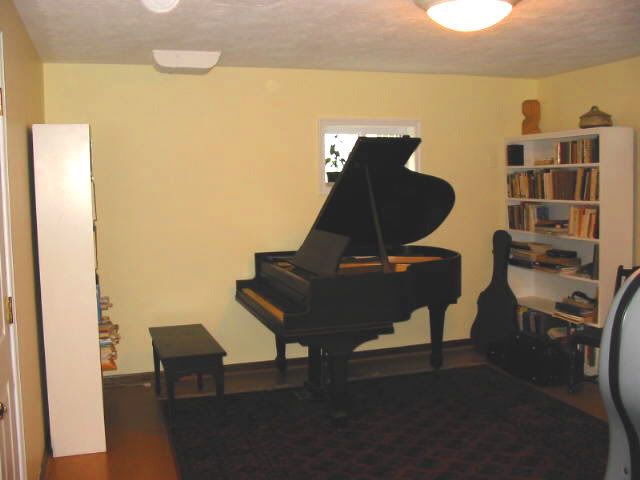


Having the piano there enabled me to play it any time I wanted to, and I found myself starting to practice again. It sounded horrible, though, and the action was rough. So I started prowling the Internet, searching for information about pianos, and as many before me have done, stumbled on Piano World.

My first thought was of having the Baldwin worked on -- new strings, hammers, and all the rest -- but the fact is that it was never a fine piano. Though my friends had always imagined it was a good instrument (it had been purchased new by their grandmother), in reality the small size is simply not compatible with a great tone, and as a practical matter, laying out the money necessary to fix up such a piano, probably around $4,000, is generally not a good investment. The thing is, you can't tell what it's going to sound like until it's done, but it's most likely going to be disappointing when you're starting with a nonprime piano like this one. Also, the poor thing had not been treated well before it came to our house. It had been kept in a room with no humidity control for many years, and there were some cracks in the soundboard that may or may not have been fatal. The more I studied the rebuilding option, the less worthwhile it seemed.

Then, also as many others do, I looked for a used piano that would satisfy me, a Yamaha or Kawai or something similar. I made the rounds of all the local stores, playing new and used, expensive and not. I visited Piano Row in New York and checked out all kinds of pianos. I kept coming back to the thought that although it was possible to buy an okay used piano for, say, $10,000, that is still a lot of money for something that wasn't really what I wanted. Just as I had done the calculations and decided it was a better investment to buy a house than a condo, I decided it was better to buy the nicest piano I could find that I could afford rather than the cheapest. (To read about how I could afford to buy a better piano, see this post.)

It was on Piano World that I read some of the buzz about Estonia pianos. Estonia, a small Baltic country, had a piano factory that was founded in 1893 and produced nice pianos. When the Soviets took over the government, they took over the piano factory as well, and quality declined. After the fall of the Berlin Wall, Estonia regained its independence, and the factory workers privatized Estonia Piano in 1993. A young Estonian pianist named Indrek Laul, a Juilliard graduate, started buying out the business in 1994 with the aim of creating a world-class piano. Within 10 years, there began to be much discussion in piano circles and even elsewhere about these surprisingly good pianos. For example, in 2003, an article was published in Forbes magazine:


A Fine Way to Treat . . . an Estonia


I was intrigued. When I finally was able to try an Estonia, I was impressed. The touch was especially good, and the quality of sound was almost as good as the best Steinway B I had played (~$70,000 -- no way!). There were other pianos that I liked, but they were much more expensive and only marginally better, or perhaps just different. I made a deal with a local dealer, and in July of 2006, my Estonia 190** was delivered.

I've been spoiled, practicing on this piano. It responds so well. I wish I had a bigger room for it, but the current setup more than meets my needs. I've had people come over, say they've never heard of Estonia, rattle off a few chords, pronounce it "bright," and leave obviously thinking I bought some odd piece of junk. But I'm the one who plays it every day, so it's my opinion that counts. My playing has improved tremendously since I acquired this piano; I'm able to produce many more nuances of tone and dynamics than on either of the Baldwins, and it's simply more pleasant to play on.

The fate of the old pianos? The Hamilton is still in the living room. I have it tuned once a year or so and play it once in a while. It's not a bad piano. It's among the last pianos that Baldwin made as a company in the United States before they were bought out; the new owners just slap the Baldwin name onto pianos made in Asia, and I don't know what they are like. It was designed to be a basic, sturdy workhorse (this is the model that used to be ubiquitous in practice rooms all over the country), and the craftsmanship with which it was made is high.

The touch and tone that I once thought were fine now feel loose and a bit clangy, but I've found that is characteristic of every Baldwin I've played. I've thought of selling it, but the few thousand dollars I'd make would not change my life, and it's kind of nice having a piano with such a different touch available -- I can try out pieces on it to see how secure they are without the support of the Estonia, and it's interesting.

As for the baby grand, I tried to give it away, but I couldn't find a suitable recipient. Our friends didn't want it back. I advertised on Freecycle and our neighborhood listserv. I was perhaps too honest about its problems, or maybe people just don't want to be bothered with such a thing these days. In any case, in the end I had it taken away by the movers who brought the Estonia, and I don't know what happened to it after that. Perhaps it was taken to a junkyard, perhaps it was dismantled for parts, perhaps it was turned into a minibar, or perhaps someone took it home and is playing on it right now.

*I wouldn't bother Googling this; there probably is nothing about it anywhere, and I've never seen another one. Maybe ours was the only one!

**190 refers to the length of the piano in centimeters, equal to 6' 3" in U.S. measurements. This is considered a "parlor grand" -- I guess referring to the days when people had parlors that were bigger than today's living rooms. Concert grands are generally either 9 or 12 feet long.

Sunday, November 29, 2009

How to sell a cello

Short answer: With great difficulty.

Long answer:

I had owned my Italian cello for about 25 years by the time I went about trying to sell it. People had always expressed admiration for this instrument, and even some envy. I had it appraised every few years for insurance purposes, and the value went up every time. My parents paid around $8,000 for it in 1979; the last appraisal was for $35,000.

I was surprised, then, when sometime in the 1990s, I took it to one dealer who flatly refused to sell it for me. He seemed suspicious but didn't give me any concrete reasons for his suspicions -- at the time, I thought it had something to do with the condition of the instrument -- and I didn't pursue it. I hadn't entirely made up my mind to sell it at that point, so I put the idea back on the shelf for a few more years.

In 2004, I contacted an online auction company that had been holding some well-publicized successful auctions of large numbers of stringed instruments, getting good prices. Selling an instrument like this on consignment from a shop usually takes many months, or even years, whereas an auction is a way for many people to see the instrument in a short time. The auction company physically collects the instruments and puts them on display for a week in a rented showroom; they also issue an online catalog. People can come and play the instruments and then, when the auction begins, bid online.

After I contacted them and explained what I had, one of their people arranged to stop by my office downtown and look at the cello. He was impressed, and went back to his office in New York and wrote up a contract. In it, he described the cello as "Italian," and suggested a value of between $30,000 and $50,000. A month or so later, he came by my house to pick up the cello.

The week before the auction arrived. I looked up the catalog, and my cello wasn't in it. I had not heard anything from them, so I called to find out what was going on.

The same person who had met with me twice and who had written up the contract very calmly told me that their experts had been unable to authenticate the cello, so they had decided not to sell it. I was shocked -- both at this pronouncement and at the fact that they hadn't seen fit to even drop me an email to let me know. If I hadn't called them, what would have happened?

Apparently, the cello was decidedly not characteristic of the maker whose name was on the label. Several of the experts doubted that it was even Italian. I did a little research and found that a member of the labeled maker's family was still in the luthier business in Italy, so I emailed him some photos of the cello. He agreed that it was probably not made by the person named on the label, and that it was possibly German.

Now, this does not have the same implications as, for example, a cello labeled a Stradivarius  being exposed as a fake. The maker on the label of my cello was considered fine but not at the highest levels of the art. It's like someone who always thought they were John Smith finding out that Mr. Smith wasn't his father and that his father might possibly be Mr. Jones instead. John Smith still has all the same talents and attributes, just another name -- and oh, yeah, he won't inherit Mr. Smith's estate after all. So my cello wasn't a Smith but possibly a Jones, and wasn't worth $35,000 but maybe $15,000.

The dealer who originally sold the cello to us had died a number of years before, but his son had maintained the business and happened to be at the auction checking out the instruments. Because his shop's name was on many of the appraisals, they had consulted with him, and the upshot was that he volunteered to bring the cello back from New York. I eventually talked to him on the phone. His only explanation for the poor ID on the cello was that it was a long time ago and they didn't have the resources available now to check things out. Um, yeah, okay.

He obviously felt some responsibility, because he said he would fix the cello up for me (clean it up, put new strings on it, etc.) and would sell it for me without charging a commission. He did say, though, that it was a really fine cello and that he thought I should just keep it. I decided to bring it home and see how I felt about it.

Fate seemed to be checking to make sure I really wanted to go through with this. There I was, with the two cellos side by side. I didn't even have the incentive of making a big profit on selling it -- and in fact, wasn't even sure I wasn't being scammed about this whole thing. In the end, though, I still liked my new cello better than the old one, and still didn't like playing the old cello anymore. I had moved on.

I eventually took it back to the shop, and six months later, someone bought it. I used the money to pay for most of the cost of my new piano. I still consider it more than a fair exchange.

Saturday, November 28, 2009

Instruments

I've always loved musical instruments, that you could hold or touch this finely made object and use it to make nice sounds. Maybe because I was always so shy and quiet, speaking through an instrument was compelling.
Pianos didn't seem like instruments to me when I was a child -- they were more like furniture. I didn't exactly relate pressing the keys with the idea of a hammer striking the strings to make sound.

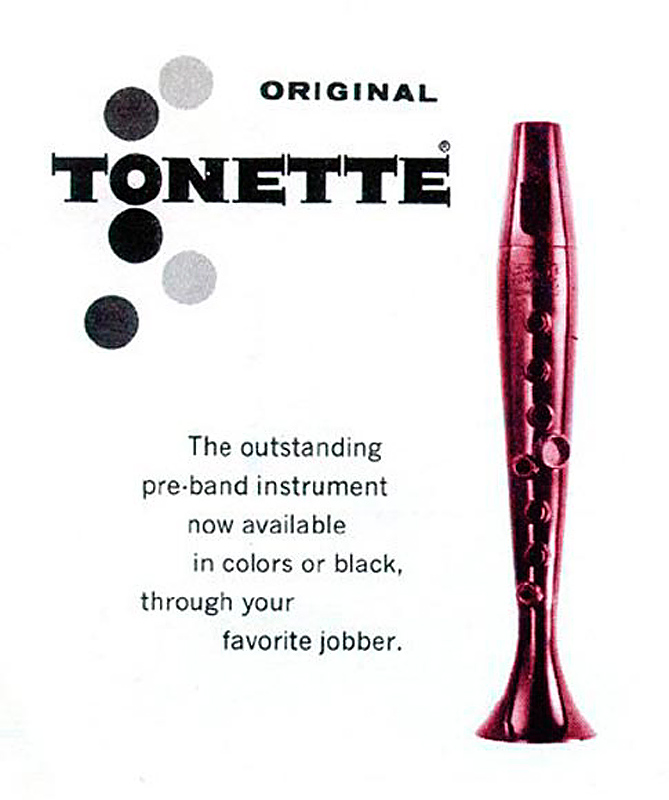
Fourth grade was when, in the DC public school system, kids could start learning a musical instruments. I knew I wanted to play the clarinet. But at the last minute, we were told they'd canceled the program. We did get classes on the tonette, a little plastic thing that was a cross between a recorder and a pitch pipe, but sad to say, I didn't become a tonette virtuoso.

We didn't have another chance to choose an instrument until seventh grade -- junior high. This time around,  I picked the cello. At first I borrowed one from the school; then my parents rented a three-quarter-sized cello from a Music and Arts Center. All I remember about it was that it was shiny. After about a year, I had grown enough to need a full-sized cello, so my mother and I went to Chuck Levin's to pick one out.

The store sold mostly guitars and band instruments, but they had a small selection of strings for students. My mother was pushing for the cheapest one, a plywood Kay.  It looked like this:


though of course it had a tailpiece, bridge, and strings; the name was emblazoned in chrome script on it:


I somehow knew that a real wood cello that was a copy of a Stradivarius would be significantly better. I think it was about $10 more than the Kay, so we bought that.

Other instruments acquired during this time:
  • A metal clarinet that had been used in a marching band by some relative of my piano teacher; I futzed around with this instrument for a while but couldn't get more than a squawk from it.
  • A nylon-string guitar from  Sears that I had a lot of fun with, playing chords and singing along.
  • A soprano recorder that I taught myself to play.
During my second year of junior high, I became interested in the flute and borrowed one from the school. Again, I taught myself to play it from a beginner's book and even played in the all-city band one year (last chair). I really, really wanted a flute, but my parents said they'd already bought me the cello, and that was enough. I kept looking at flutes for some years but eventually lost interest.

I kept that first cello until I graduated from high school. There was another cellist in the youth orchestra who also studied with my teacher and who was the same age as I. She was his most serious student and wanted a career as a cellist. He had picked out a cello for her when she was about 15 years old, a German-made solid instrument by W. Fuchs, with a dark, rather ugly reddish varnish. She hated it, and I think she must have pitched a number of fits until her mother bought her a better cello. The Fuchs was then passed around for trial among the teacher's other students and eventually ended up with me. I hadn't even thought about getting another cello, but for some reason my parents decided to buy it for me.

I don't remember thinking much one way or the other about the quality of this cello. It was a sturdy thing with a strong sound but not a lot of complexity or refinement, much like my playing at the time, so it was a good match. I kept the Fuchs for about five years, until my second year as a music major, when I started shopping for another cello. At that time, before the availability of inexpensive, well-made instruments from China, it was difficult to find anything decent at the price we were thinking of paying. I eventually tried a cello in a local shop that had an Italian label; It had a light gold varnish and a sweet tone, like a high operatic tenor. My teacher liked it right away; we even took it to another dealer to have it evaluated (though I suspect he wasn't likely to say anything bad about it because his shop was in the same building as the seller's). So my parents bought it for me. My teacher said this cello would last me through any career I would have -- and so it did.

I toted that cello around to every venue and location -- North Dakota in the dead of winter, Texas in the height of summer, playing indoors and out, in Carnegie Hall, on the street, on a boat, in nightclubs. It survived all that well. I always got compliments on its sound, and in fact, it was a bit of a joke to me, and sometimes irritating, how often people would say, "Your cello sounds really good!" (as if it played itself).

I had thought I'd never sell it. Italian cellos are not that easy to come by and are expensive; I knew I'd never be able to afford another one. Even though after I finished graduate school I was playing less and less, I kept thinking, what if I was asked to play someplace where it mattered? What if I had to play a concerto with an orchestra or a solo recital? None of these theoretically important events materialized, however, and for some complicated reasons I developed an antipathy to my cello. I could barely stand to play it at all.

At this point, I came up with the idea of buying a cheap cello to see if it would be adequate for my needs and then selling the Italian cello. I started haunting Ebay and various Internet discussion boards. I even considered, out of some twisted nostalgia, buying a Kay. During this time I thought more about cello construction, tone, and aesthetics than I ever had before.

This was also the time when I was taking viola lessons. I'd made a few forays into Internet buying, ending up with a Gliga viola (made in Romania; not at all bad, but nothing special). I finally gathered up my nerve and made a trip to a string shop to try their lowest priced cellos. Why did it take nerve? I suppose because the string world is small and gossipy, and I knew it might become "known" that I was downgrading, or something like that, but at that point, I didn't much care anymore. But the way I explained it to the salesperson was that I was looking for a second cello.

I tried all of the cellos they had that cost less than $10,000 (which, for those who may not know this, is considered a small sum to pay for a stringed instrument; it's what an okay cello for a young student might cost). There were several possible candidates, but then I saw one more sitting in a corner. It was a larger model, with a warm brown varnish and a smooth, deep, clear sound. I couldn't believe it, but it was actually perfect! I took it for a week's trial, but I knew this was the one.

The shop had put its own label in it, but someone had written "Snow Violins, Brooklyn, NY" on the edge of the label. Turns out that Snow is a Chinese luthier who makes a line of high-quality student and professional level stringed instruments: Snow Violin

One of these days, I want to take the cello up there and ask them which model it is (I'm sure it is one of their basic ones) and what it was doing in the shop here. My impression was that the local shop was having a hard time selling the cello because it was so large that young students and amateur players were not interested in it. They sold it to me for a very modest price and gave me a big discount on the extra-large case I had to get for it.

Next step: Selling the Italian cello. To be continued . . .

Saturday, November 7, 2009

You can tune a piano, but you can't tune a fish

The player of a stringed instrument has almost total control over intonation. Each string can be tuned, as well as each note. Even varying bow pressure and speed affect intonation.

One has no direct control over the tuning of a piano unless one is specially trained. A piano has 88 notes; the two lowest octaves usually have two strings each, referred to as bass strings, and all the other notes have three strings each. All of these strings need to be tuned. A further complication is deciding on a tuning system that is the best compromise between exact scientific tuning (which will not sound in tune) and some sort of "well-tempered" system, in which any note can be played with any other note and sound harmonious. This is a vast oversimplification of a hugely complicated topic. One interesting reference is a book by Perri Knize, Grand Obsession, in which she describes her search for a piano, which in turn leads her directly into the tuning topic. The frustrating fact is that how a piano is tuned is intimately connected with how it sounds and ultimately how musical a performance can be, but the performer is dependent on a technician to achieve the desired sound of the instrument.

The main thing a piano owner can do to keep the piano in good shape, besides having it tuned regularly, is to control the humidity in the room where it's stored. Because a piano is made mainly of wood, humidity (and to a lesser degree, temperature) affects everything about it. I keep my piano in a closed room. It is on the basement level of our house, so I run a dehumidifier in there except in the driest weather. I also have a heater bar installed under the belly of the instrument that supposedly keeps the soundboard from becoming damp; it turns on automatically when humidity in that area rises above 50%.

I can hear whether a piano is in tune, up to a certain point, but after that point it becomes a matter of judgment.  Because I am not a very hardware-oriented person, I have always tended to leave this judgment up to the technician. I am realizing, though, that I need to get more involved. This was reinforced by my recent tuning experience (what inspired me to bring up this topic here). After a routine tuning about a month ago, I went to play my piano (eagerly anticipating the fresh tuning rush) and was disappointed to hear it sounding sour, dull, and clangy. I tried to stick with it for a few weeks, but finally called the shop that had sent out the tuner. I bought the piano from them, and I have used only their tuners in the time that I've had it. As I explained to one of the owners, this is the first time I've had a serious complaint. The upshot was that they scheduled the tuner to return and touch up the tuning.

He ended up retuning the piano, spending an hour and a half. It sounds much better. However, I am still unhappy about the brightness of this instrument. "Brightness" refers to the ringing, piercing qualities of a sound; obviously, some brightness is good, but I'm starting to wonder if this piano is just too bright. It's certainly overwhelming in its small room unless I keep the lid closed and muffle it with quilts. Piano techs can do something that's called voicing, in which they tinker with the hammer felt, fluffing it up with needles to soften it and injecting chemicals to harden it, but there's a limit to what that can achieve.

Do I need to shop for a different piano? Or just a different technician? Something to think about. In the meantime, I'll keep the quilts on it and keep practicing.